Monthly Archives: December 2010

Naming is seeing the thing one sees for the first time.


I experienced solid ground for the first time at nineteen in a plant taxonomy class at the University of Wisconsin. Gradually as I learned about buds, branching patterns, bark and leaf shapes, the confusing forest of my childhood became a series of individual identifiable trees. In this new world of science a Douglas fir was a Douglas and a White oak was a White oak, This fact was not open for the Fruedian interpretations of my father or the art historical perspectives of my mother.
Ellen McMahon

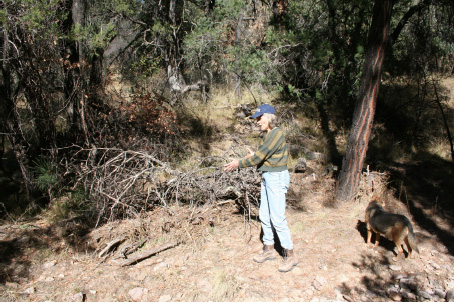
Now, forty years later as part of Art Lab at El Coronado Ranch I walked through a field of tall dry grasses as Valer Austin, said, “Take a picture. It’s all about the grasses.” As founder of Cuenca Los Ojos Foundation she is restoring hundreds of thousands of acres of the border region to the grasslands it once was before the effects of logging, overgrazing and border wall construction. The over fifteen species of native grasses now thriving on the Austin’s massive ranch as a result of water conservation and management–provide nourishment for their cattle and wildlife of all kinds as it protects the soil from erosion.

The next day I walked through the same field of tall dry grasses with my sketchbook and camera to see how many kinds I could identify. Turns out there were nine species within reach on the hillside where I sat. I looked, made drawings and took pictures and video. I didn’t know what the distinguishing traits were so I looked carefully and recorded everything I could see.
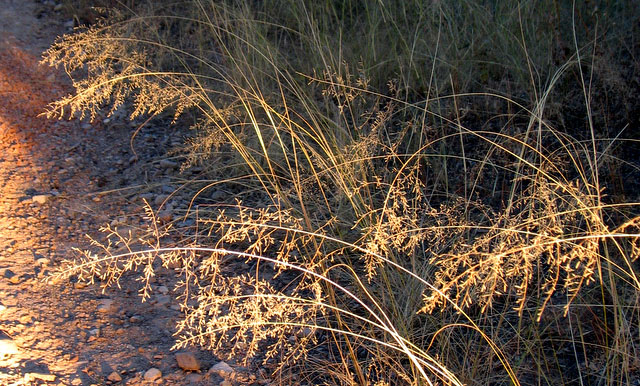
A few hours later returning to the ranch the same field was now populated by groups of fluffy ones, tuft-y ones, three branching ones, many branching ones, reddish ones, sticker-y ones, delicate ones, stiff ones, and fountain-y ones… grasses I had come to know by character but not yet by name. After I studied the guidebook and got help from the Austins I went back out to walk through the same field which had been transformed by my new knowledge into Weeping lovegrass, Slender Grama, Feather fingergrass, Green Sprangletop, Tanglehead, Plains Mountain Blue Grass, Poverty threeawn, Deer Grass, and Squirreltail.
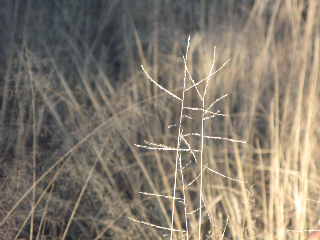
blades of ranch grass

The second day I went out with the intention of drawing and photographing more of the diversity of grasses on the ranch but it didn’t happen. Perhaps I had established sufficient ground the day before. Instead, taken by the gentle movement of the grasses in the soft breeze, I shot video. When my memory card was full I went back to my room and picked up my reading, Seeing is Forgetting the Name of the Thing One Sees by Lawrence Weschler.

Bathed in the contradictions between my reading and my experience, I don’t expect to understand the relationships between seeing, knowing, naming and forgetting any time soon. But now when I take my weekly walks up Tumamoc Hill, I’ll think about Dr. Ray Turner and know I am surrounded by the oldest desert vegetation study plots in the world. When I look out over a section of the desert infested with Bufflegrass I’ll know that all of the native vegetation could be wiped out by a single fire. Now I know that over 100,000 people come to the Biosphere annually, many because of the human drama associated with the Biospherians, and they learn about how useful it is as a model for interdisciplinary climate change research. I have a good sense of the multiple stresses on the Southwest environment and the urgent need for more public dialogue and understanding about the trade offs. Occasionally I will think about every living thing on earth having once been part of a star.

In Seeing is Forgetting the Name of the Thing One Sees, Robert Irwin talks about the reasoning in art making and the logic of scientific research. Is the shift I made between naming the grasses the first day and seeing their character in motion the second a tiny example of the shift between logic and reason? How do the qualities and characters of art and science overlap and differ, support each other and work at cross-purposes? Art Lab has been informative and thought provoking. Maybe the work that comes from the experience we shared will shed some light on these questions and relationships.
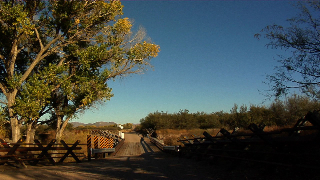
Cuenca Los Ojos


The US-Mexico Borderland

There is urgency to understand the environmental changes of the last 150 years of the Arizona-Sonora Border region and it’s north-south corridor.  We were given the opportunity to experience this exigency first hand by Art Lab at the Cuenca Los Ojos Ranch in southern Arizona.  Valer Austin, director of the Cuenca Los Ojos Foundation is a generous, infectious power-house and advocate for environmental restoration.

Austin’s projects located on both sides of the border are immense, inspiring undertakings.  Her vision is practical and intricate.  She foregrounds water restoration as her primary goal to re-establish healthy plant life and animal migration.  We learned the story of this land through observing Austin’s courage and passion to bring it back to health.  Her commitment has motivated me to develop a site project to further understand the environmental history of the Arizona-Sonora borderlands and human and nature’s migrations from a cultural and ecological perspective.

Dreaming of a New Biosphere


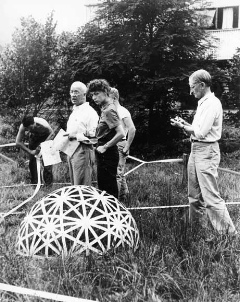
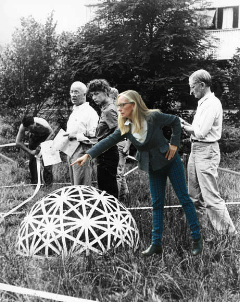
I wanted to be dreaming or imagining Biosphere 2.  The material site extracted my life’s visual memories of cinema, architectural pilgrimages and the beloved, indulgent, unrequited fantasy of having been Bucky Fuller’s student at Black Mountain College.   I long to have been part of Fuller’s “doing more with less” idea and the experiential learning that fueled the dome’s invention, construction and design.

Buckminster Fuller and Ellen DeKooning at Black Mountain College

The ideology and purpose of Biosphere 2’s enormous space-frame structure (rife with iconic architectural quotation that looks back and gazes forward) is under transformation.  Biosphere 2’s new mission and research program promises to bridge the gap between its former closed-system laboratory and field studies, focusing on water and climate and energy and sustainability.  This is a bold sea change from the hermetically sealed structure originally built to house experiments that modeled habitats for extended space colonization and survival.

My attention became increasingly divided between the urgent present-day mission of Biosphere 2 and the big imaginative late twentieth century experiment that was embedded with imperialism and utopian vision.  I wanted to grasp the invention and potential of the current twenty-first century model and to understand the important lessons from the grand imaginative experiment that contained plants, animals and humans in a closed system.

 During our first 4 days at Art Lab, Biosphere 2’s present-day researchers and scientists acted as generous, informed guides, the archeologists and anthropologists we met were inspiring, and the artists courageous.  Regardless of our days lecture topic the dialogue always returned to water and the changes in the Southwest since European contact.  Environmental, cultural and scientific histories, domestic public policy as well as global views were examined.  Ideas and possible solutions flowed.

Photoshopping my way into Black Mountain College

Taoism suggests that we be as flexible as water.  That we become able to let go of old models that don’t work and act with creativity and humility to find new ways of being.  Understanding ways that art can respond to this charge is foregrounding my research and ideas.

Art Lab: Perception


Sheila_Rocha

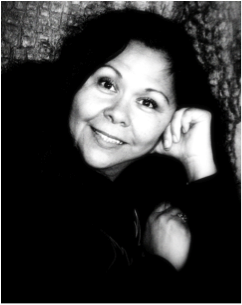
This journey into earth preservation feels to be just the beginning of a greater understanding of how I can contribute with my art and my hands to the process of geo-healing. As a Purépecha, an indigenous citizen, I have understood what it is to honor our mother the earth through acts of ceremony and conscious caring of the terrain. The Art Lab adventure opens new ways in which I can directly participate in restoration and conservation as an act of intervention. It is clear that all humankind has much work to accomplish in order for mother earth to prevail for our coming generations.

The Biosphere 2 facility provided a unique opportunity for us to interrelate with on-site scientists. Although it brought the issues of hydrology to the forefront, it did not illustrate the omnipresence of the state of climate change that immediately impacts the human condition on multifarious levels. The biosphere provided fundamental background on current research and methodology.

It was our visit to the Tumamoc desert laboratory with Dr. Raymond M. Turner and his work with archive repeat photography that magnified the imminence of climate change. The longevity study on desert flora was one of the missing links I was looking for. Tumamoc also revealed itself as an ancient sacred site—one that is
directly connected over the millennia to its descendents, the Tohono O’odham. What I
observed was scientific appropriation of the area however, total absence of the O’odham in stewardship and protection of these ceremonial ruins—a place where cultural reclamation needs to occur—yet another aspect of preservation.

The full dilemma became clearer as we moved to the U of A for summarization of what we were looking at in terms of total climate modification. However, not until we stayed at Cuencos Los Ojos ranch, hub of the foundation by the same name, did I observe the actualization of comprehensive restoration initiatives.

Here is where things began to come full circle. Here I witnessed Valer Austin, the human trope for environmental conservation demonstrate how human beings have the power to wound as well as to mend our earth. Valer institutes everything from protection and replenishment of natural resources and fauna to water harvesting and education of the larger world community.

This experience, for me, became the “decisive moment”. Art and labor are tools at our disposal. We, as earth citizens, make it or break it for humanity. Now the question…how do “I” contribute to the healing as resourcefully as possible? This realization becomes the springboard for the creative process pulling me into an exploration of sound, image, movement and more.

Stitch: mending the land


Vidar Lerum

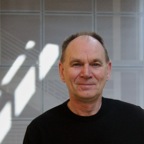
While at the ranch, we got to build two small gabions. This physical practical exercise made me appreciate the hard work and the immense effort that goes into this method of land restoration. Earlier that same morning I had listened to Valer talk to me about how it all started and how the system of gabions is working.

Valers_with_Gabion

She then spoke about her vision for a more peaceful future in the border region where land restoration goes hand in hand with providing meaningful employment for young people, making the drug trade a less attractive business to join. A transcription will be made from the video that documents Valers private talk with me. I may also do some video editing and perhaps use Valers voice over moving images. In an effort to visualize the land restoration project at El Coronado, I plan to create a series of graphic images or posters. The base for these posters will be aerial photographs of one particular area taken at intervals over ten years. Cindy was very kind to identify and pull the images that I will use.

Burn : Buffelgrass fire


Vidar Lerum

What stands out in my memory from the first half of the ArtLab week is the talk about the Buffelgrass. We learned that Buffelgrass burns at very high temperatures and that the fire can reach a peak temperature of 1600 degrees Fahrenheit.

I contacted a colleague at UIUC and learned that carbon steel starts to loose its structural strength at 900 degrees F. The goal of my experiment is to heighten the awareness of the Buffelgrass invasion by visualizing its properties and opts strategy in taking over the Sonoran Desert. The experiment will be documented by time step photography and video.

An abstract representation of a saguaro cactus with one arm is built using thin steel string of the same type use in gabions. A carpet of Buffelgrass will be creeping in from the side until it covers the ground around the Saguaro. Then it creeps up and stuffs the wire mesh from the inside. A fire starts on the ground and will move up into the saguaro. The wire mesh will loose its strength and the cactus collapses. This experiment is on the dark side. Its focus is on the destructive nature of the Buffelgrass invasion.