Monthly Archives: January 2012

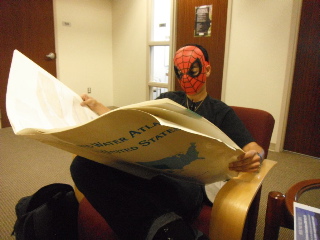
Melo’s Journey


melo spidey

My experience being part of the Rillito River Project was an amazing one. Originally from Los Angeles and now a Tucson resident, The Rillito River Project exposed me to a lot of valuable information about the environment and inspired me to learn more. Our experience began at Biosphere #2. We spoke to many different scientists about their work and our group was given a tour of the biosphere. The thing about the Biosphere is that you have to think of it as a living thing you are able to walk through and semi control. It’s a very cool experiment.

After our 4 days at the Biosphere we headed down to Cuenca Los Ojos in the Chiricahua Mountains. We stayed at the Coronado Ranch, an amazing place. Valer Austin has many acres of land both on the U.S. and Mexican side of the border. She invited us to see what she has done to raise the water table and reestablish native grasses on her land by building simple rock dams called gabions. We also had a chance to see how the border not only keeps people from their natural migration but also keeps animals from their natural migration. Being on the Coronado Ranch and meeting with Valer was a very inspiring experience. We had the opportunity to see what one person can do to make a huge change for the better.
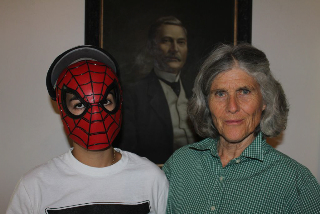
melo and valer

I learned a lot from this experience. With this new knowledge I would like to use my skills as an artist to share it with others. I feel that if people knew more about how climate change is effecting our environment they would be willing to make the necessary changes. The first project I have in mind is to create a painting of the Mexican Free Tail bat. It lives in Tucson six months out of the year and helps our local farmers control the bug population. It also eats mosquitoes and is a delight to have as a summer resident. I would then love to make my painting into a large-scale mural that the people of Tucson can appreciate and learn from. This is the project I would like to do as a direct result of my Rillito River Project, Art Lab, experience.
Hope and uncertainty


Learning in dialog with scientists, conservationists, naturalists, astronomers, activists, and artists at the Biosphere 2, The Institute of the Environment, and Cuenca Los Ojos was an exercise in interweaving uncertainty and hope.  At the Biosphere in discussion with scientist Sujith Ravi, the challenges facing the southwestern grasslands were enumerated thoroughly.  Water usage changes, desertification, drought, invasive species, rising temperatures–all the data presented a bleak and uncompromising picture.  At The Institute of the Environment in discussion with Dr. Jonathan Overpeck, the frustrations of scientists who feel misunderstood and suppressed were emphasized.   Climate change is here, policy is not changing, behavior is changing too slowly, and the mechanisms of capitalism in service of endless growth work against the needs of climate recovery.

Its hard to make artwork in the face of these questions.  Complex, abstract reams of undifferentiated data about the future lack a felt reality.  The timescales are long and the sweep of effects broad, but it is in looking at the shorter timescales and local experiences that the abstract becomes real.  Those local discussions were riveting and even hopeful, whether learning of the work of how to fight the disastrous effects of the invasive species Buffel Grass as it spreads rapidly through Tucson and surrounding areas, so clearly shown by Lindy A. Brigham, Executive Director of the Southern Arizona Buffelgrass Coordination Center, or Valer Austin’s determined remediation of desertified land to restore biodiversity in the Chihuahuan Desert on her ranch Cuenca Los Ojos.

The Art Lab Biosphere project provided an incredible, rich, and surprising experience for discovering the key questions around climate change in the Southwest, challenges in working across the studio and the laboratory, and the importance of dialog and connectivity in research and community.    My project, Avian Field Stations, has a new research focus: grasslands birds in the Cuenca Los Ojos area.  I look forward to returning to Tucson and the Chihuahuan desert in the early summer to conduct field research, develop alliances with researchers, and test prototype works.