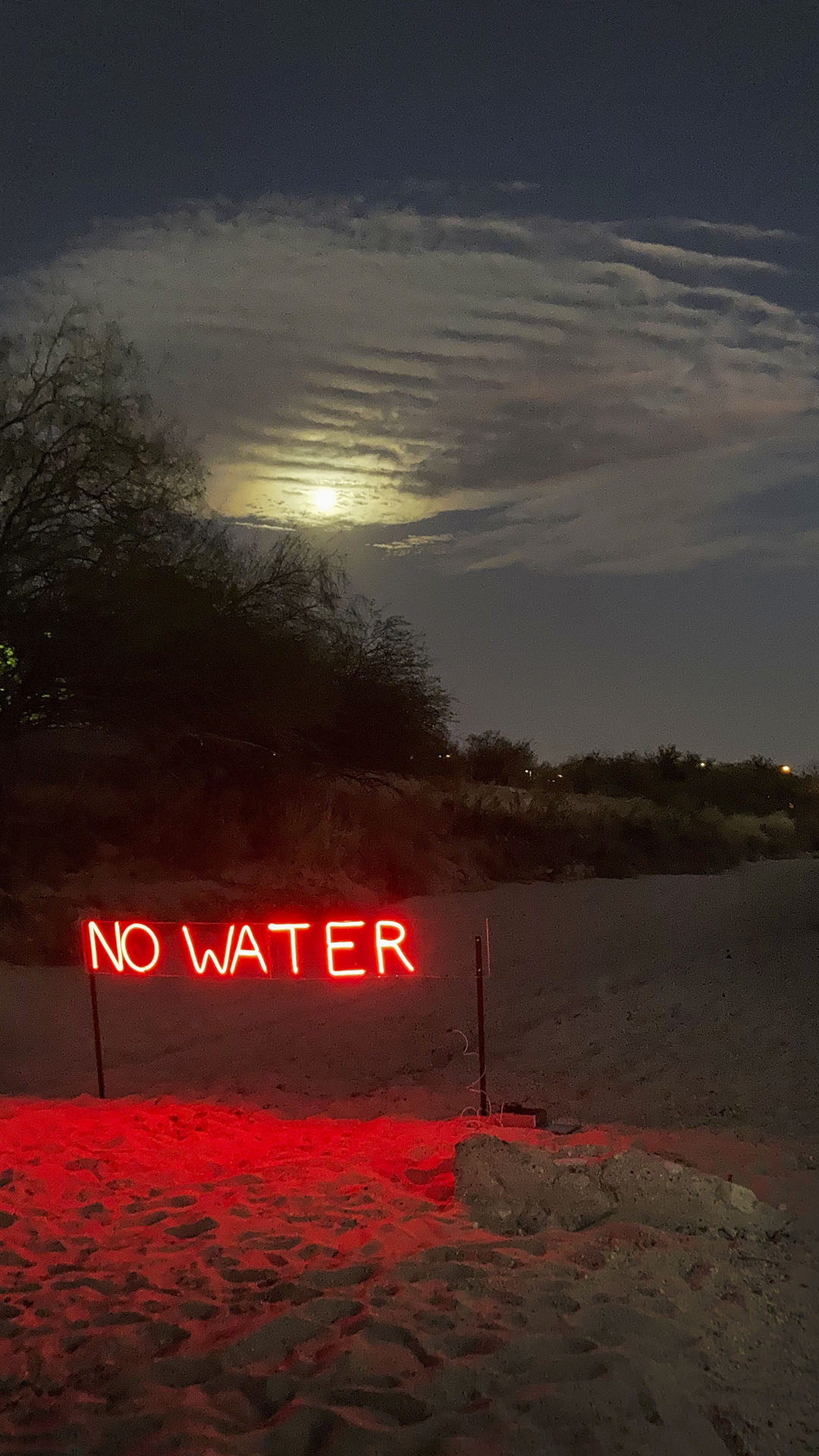
NO WATER Installation


Download NO WATER Image

Help share Rillito River’s message with the world.

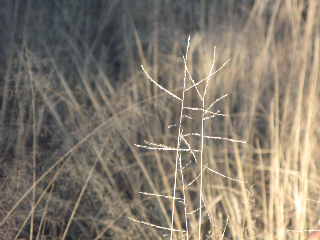
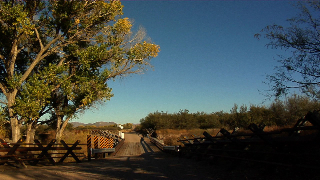
Download the “NO WATER” photo by AP Gorny.

NO WATER by Peter Gorny
“NO WATER” by AP Gorny

Credits

“NO WATER” by AP Gorny is licensed under CC BY-NC 2.0.

Terms of Use: This image is licensed under a Creative Commons Attribution-NonCommercial 2.0 Generic License. For use by individuals and organizations to build public awareness of the water crisis in the West. No commercial use. It can be shared but credit must be given to AP Gorny. 

Download Images

Contact

For more information or versions of the print, contact Ellen Skotheim.


NO WATER Installation

On February 15, 2022,  Tucson artist Ellen Benjoya Skotheim and New York artist Anthony Peter Gorny created and installed a neon sign bearing the words “NO WATER” in the bed of the dry Rillito River in Tucson, Arizona.   This installation is intended to draw much needed public attention to the ongoing Mega Drought, the longest and most severe drought in the western United States and Northern Mexico in at least 1200 years.  A study published in the journal “Nature Climate Change” concluded that human-caused climate change significantly contributes to the Mega Drought.

“NO WATER” is the latest installation of the Rillito River Project which fuses art and science to create ephemeral environmental installations and performance art events that call attention to the ongoing water crisis and climate change in the West which portend serious negative consequences to the quality of life of all people and animals living in the West.  Ellen Benjoya Skotheim is the founder and Creative Director of the Rillito River Project. 

Planting Seeds of Hope


It was wonderful for me to be reunited with everyone I built great relationships with during the 2011 Art Lab.

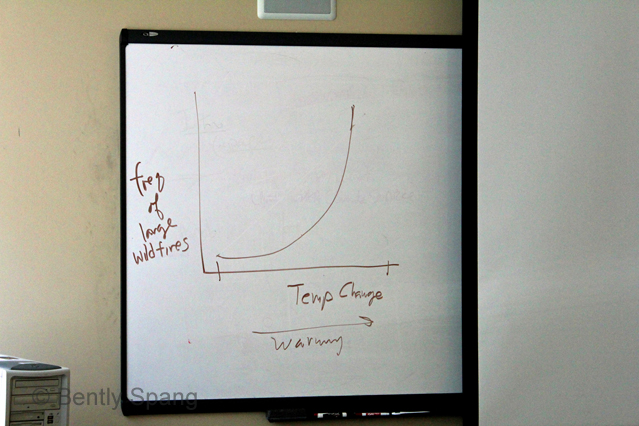
We arrived a week prior to the opening to begin installing our art at B2. I was joined by Fritz Buehner (Boston,MA), Bently Spang (Billings, MT), Ellen Skotheim (Tucson, AZ), and newest art lab artist, Morgan Schwartz (Providence, RI). Reuniting in the Thar meeting room at B2 was intense, we had all talked about how climate change had greatly affected our lives personally. Bently lost his family home on the Northern Cheyenne Nation Reservation in Montana due to the devastating wildfires in June 2012, hundred of homes were lost and over 200,000 acres of land burned. Fritz’s studio in Brooklyn, NY was flooded during hurricane Sandy. Here is Tucson we endured hotter temperatures this summer and we saw an increase in wildfires throughout the southwest.

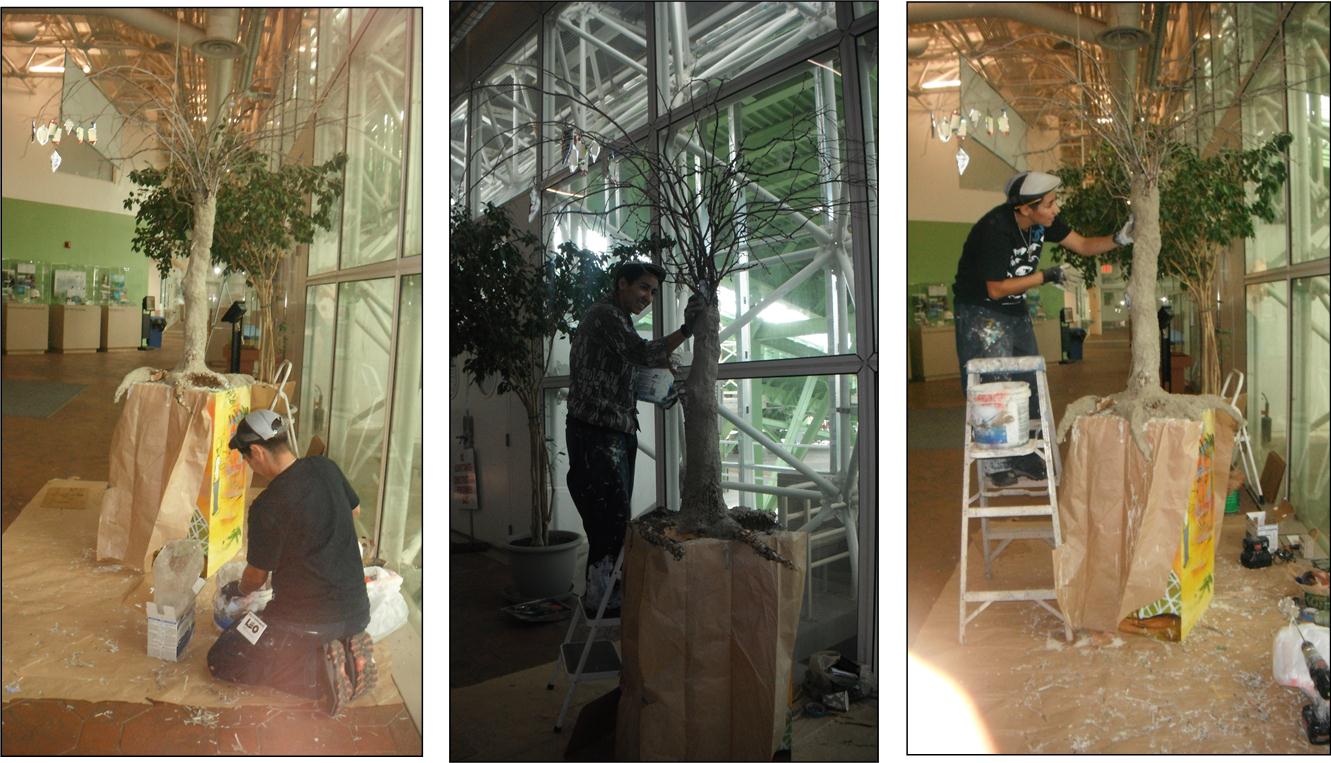
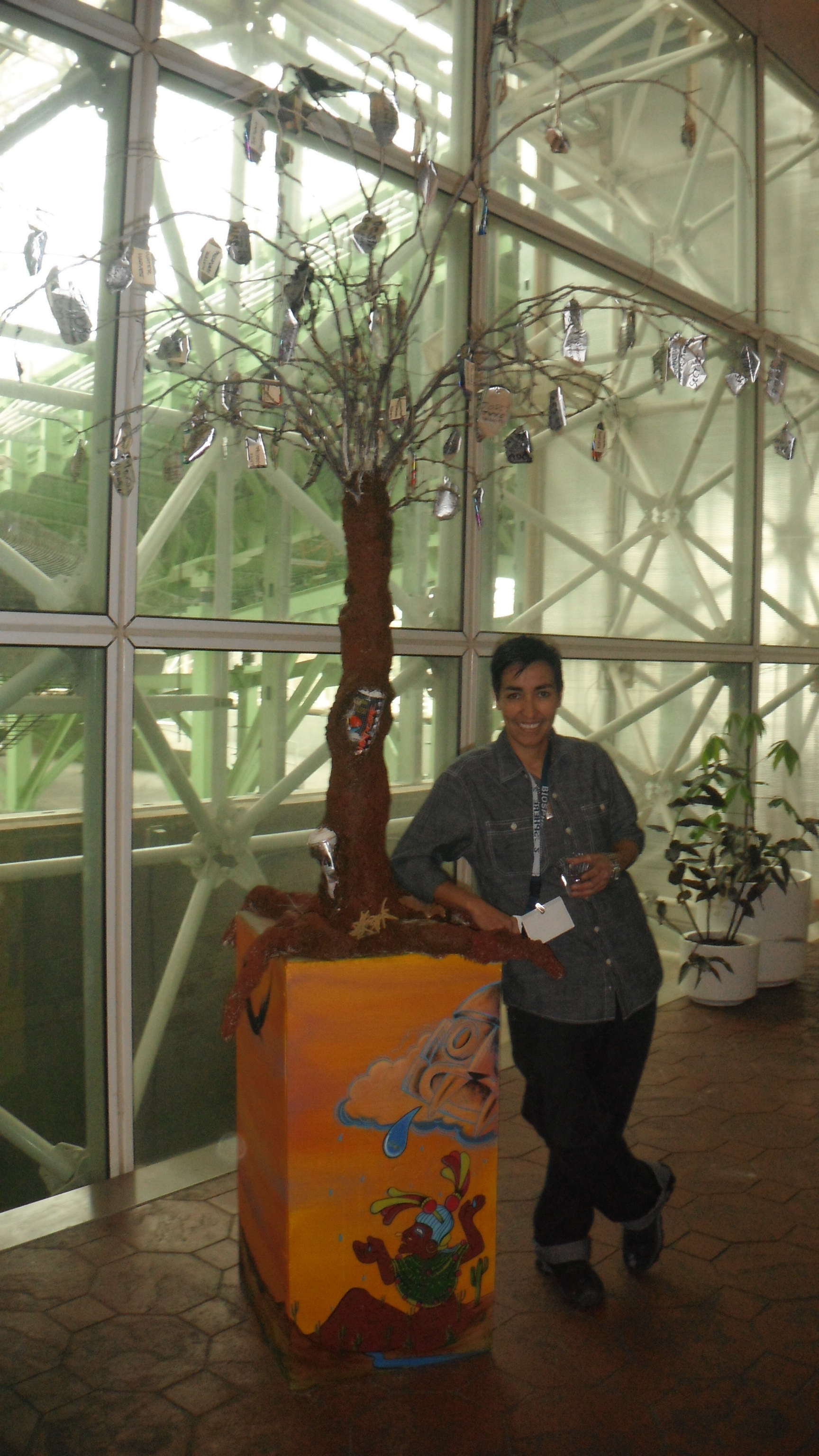
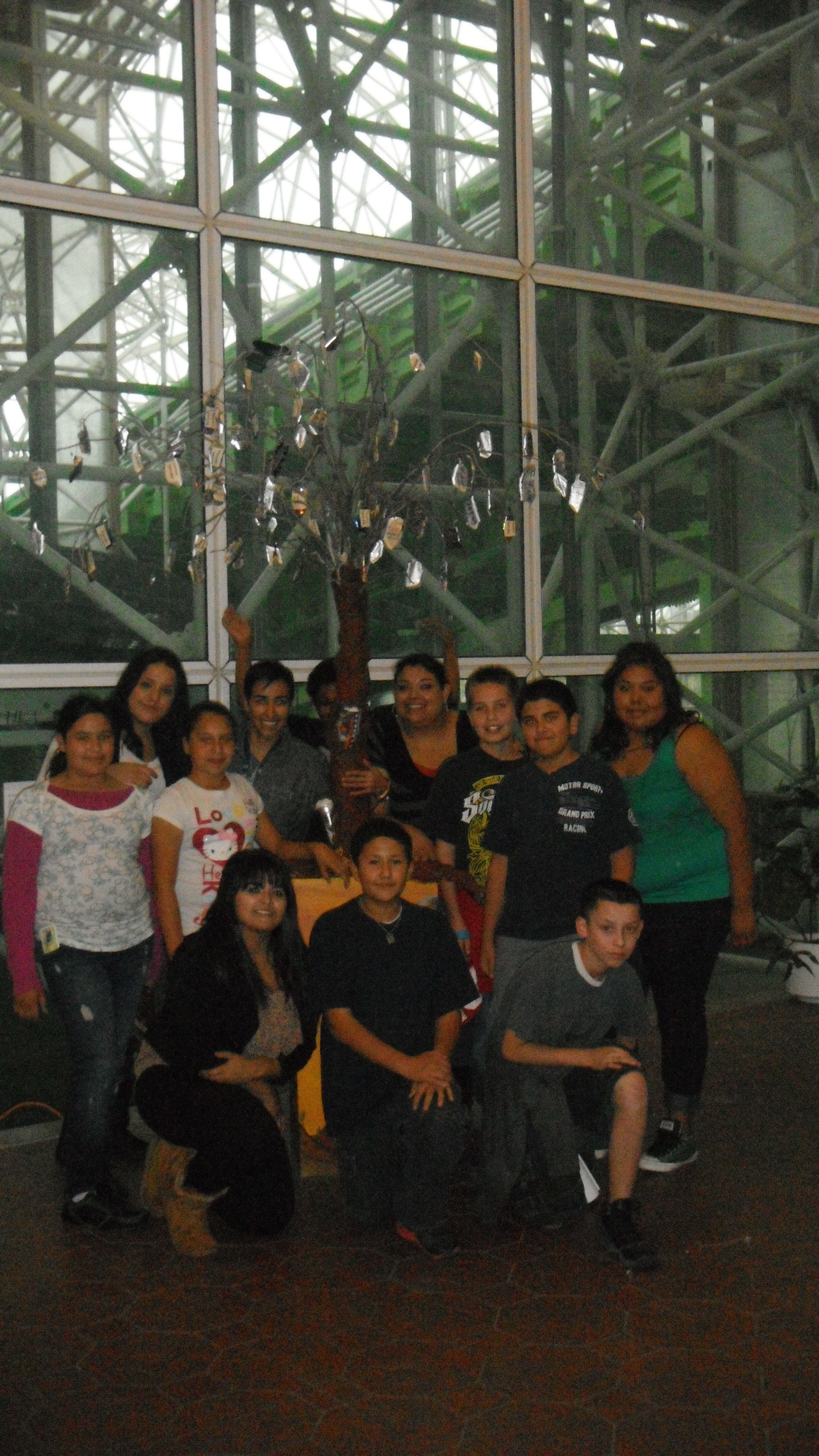
This past year I was diligent in sharing all that I learned during Art Lab and every chance I could get, I would talk to folks about the importance of water harvesting, the battle against buffle grass, increasing our tree canopy, and climate change. I also took the information into several middle school classrooms and the John Valenzuela Youth Center here in Tucson. I wanted to make sure and include these students into my art installation. When I visited youth I would bring in juice pouches for them to enjoy while they listened to me talk about climate change and then we did an art project. They would cut their pouches in to shapes of leaves and write their names and schools on them for display on my art installation “Planting the Seeds of Hope”.

During the week of installation at B2 I was able to interact with visitors while creating my sculpture. It was wonderful to meet folks from all over the country and a great opportunity to give them information on my sculpture and why art is important to get everyone talking about climate change. CSA cooked for us every night with good delicious local organic ingredients. Being at B2 with all its scientists and wonderful tour guides, Rillito River Project’s Creative Director, and the wildlife and scenery made this experience not only wonderful but inspirational. I felt like our coming together was powerful and that we can all make a positive change in our world.

Opening day of the exhibition was super awesome! I saw new and old faces and it especially felt good when I saw the youth from the John Valenzuela youth center that came to support me and visit B2 for the first time. Seeing their excitement to learn about science, ecology and art was so rewarding. I look forward to continue to network with B2, Rillito River Project and my community to do my part in planting seeds of hope.

Art of All Possibilities – Art Lab 2012


Installation by Fritz Buehner, Art Lab 2012 November 11th; after a warm reunion at Lynn Morton’s place in Tucson, Mel Dominquez, Bently Spang, and I are driving nearly a year to the day later in John Newman’s van loaded with food supplies north to Oracle and Biosphere 2. We arrive at 5:30 on a beautiful slightly cool evening and see Biosphere 2 with the glow of the sun’s last light illuminating the other worldly glass structure beyond the now familiar casitas where we will stay for the next week. Ellen and Phillipe are also there and we begin unloading our supplies.

It’s amazing to be back among friends, fellow artists, in this extraordinary place embarking on a project that has been in the making for 6 months. Morgan Schwartz will join us on Tuesday. We also nervously await the arrival of Mary Ellen Strom’s work and support material – sadly, she is not able to be with us. We hear it’s arrived, or about to, but where.

It’s Monday and we are seeing for the first time the spaces where we will install our projects. I feel uncertainty as to whether a site different from one first chosen for my installation will work, but after a short period of assessment the new space looks like it will work and shortly after actually getting to work, all seems good, almost fortuitous.

Installation by Fritz Buehner, Art Lab 2012The week goes relatively smoothly (there are always glitches) and with cooperative indeed collaborative work on everyone’s part Saturday arrives and an impressive show by six artist’s emerged as a voice joining with the researchers from The Institute of the Environment in raising awareness of climate change. Joaquin Ruiz director of Biosphere 2 spoke eloquently about the close relationship between art and scientific research and we are all feeling enormously proud of our participation in this historic moment.

So much credit goes to Ellen Skotheim, her vision and incredible dedication to not only making this show happen, but also to her passionate work on behalf the region’s environment. John Newman’s resourcefulness and extraordinary problem solving abilities, even temper and sense of humor kept things on schedule and Phillipe kept our crankiness at bay with his culinary wizardry and reminded us there is important work to be done developing regional food resources.

Fritz Buehner
12.9.2012

I in River


an excerpt from an essay
The channel at right surrounding—disappearing into—the spine of
the book is the gutter. In the unlikely event of a water landing and
your book being submerged, water would collect in the gutter. The
pages would soak through and fall apart given time. The glue would
dissolve. The stitching would rot like a long-submerged body in a river
or a lake. By this point either you would have survived or you’d be
falling apart. The binding would then fall into its component pieces,
ruining the illusion of the artifact’s wholeness you’re holding. What
is in your hands is just paper, collected, printed on. What you are
holding is just ideas and language—the usual interlocking systems of
signs—printed on paper. It is not engineered to channel or hold water,
but it can do so in a pinch.
The Rillito River does not channel water through semi-arid Tucson
much of the year. It once did, and like many modern things—like
the trains in Upper Michigan, my homeland; like Western Union’s
telegram service; like the pinching of my childhood cheek by tottering
relatives; like the streetcars in Grand Rapids, Michigan, or most other
American cities; like the increasingly anachronistic telephone cables
strung all along our highways into the second-largest engineering
project after the interstate system; like the blood through the bodies
of our forebears, our betters, our mothers, our fathers, now dead; like
the language recognition centers in my brain that fail now to bring the
words I want to mind or tongue at awkward moments; like the awesome
chugging rhetorical power of the periodic sentence that cannot
go on forever even as it aspires to—the river channels water no longer,
not year-round. But the channel’s there, isn’t it, plain as a wide June
day, scrubbed clean in many parts and bristling with brush and trash
in others, hundreds of feet across at points, hemmed in mostly
by concrete culverts, effectively separating the city from the ritzier
homes and restaurants that populate the foothills. It separates via
space and threat of sudden flood surge, a reminder of the force of
water when it’s here, a reminder of the force we deploy in trying to
contain it, a reminder of the risk we take in ignoring it.

This year natural disasters have been everywhere, it seems. As I write
this, “Tornadoes kill 6 in Oklahoma, Kansas” (CNN ), and we’re less
than a week past the devastating tornado in Joplin, Missouri, not to
mention the more obvious man-aided nuclear disasters occurring
after the epic tsunami in Japan, the tornado system that removed both
of the places I lived in Tuscaloosa, Alabama, from the map a couple
weeks back, then the crazy freeze this winter in Tucson that killed
much of the saguaros though they won’t keel over for some years, their
death delayed, and then the massive floods in New Orleans, again, the
Red River in North Dakota, the eruption of Grimsvotn, the Icelandic
volcano whose ash cloud drift threatens to scuttle my summer travel.
My mother-in-law is freaked out about the end of the world prediction
that didn’t come to pass a couple weeks ago on May 21st, 2011, not
to mention the Mayan apocalypse predicted for next year, just to name
a few anxious highlights. I mean to say that the world’s tribulations are
present like weather in my mind, this month, going into the Tucson
monsoon season.

And when the water’s here in the monsoon months of July and August,
it’s everywhere: like nothing in the north except maybe a blizzard
surge or avalanche. The Rillito runs high when it storms, meeting and
joining the Santa Cruz and moving on north, bringing what benefits
water brings to the arid bits of West that it reaches less and less each
year. It is therefore possible to execute a water landing in Tucson at
least a dozen mostly monsoon days a year.
I have recently started running much of the year myself. I do not run
high like the river or cheerful, smelly Arizona stoners. I don’t know
what drives my spur to run: a fight against my own personal beltway
westward expansion, perhaps. A connection to a fitter vision, finer
version of myself. A bit of personal engineering: clawing some control
away from age and the natural tendency of the body.
What else runs: my car (though not my old, sold, or crashed cars); my
computer; my animals when playful or fearful; machines; programmed
processes in machines; my nose in the dry air of the desert; coyotes,
rabbits, dogs, humans, lizards, and rare javelina through the wash in
the mornings when I run and spark their chase or flight; the blood
through the veins; the thoughts through the brain late at night when
they should be shutting down into easy, ecstatic dreams.
Any individual one of the brain’s channels—axon, neuron, dendrite—is
idle much of the time, though not to say empty or dry, exactly. After injury
or catastrophic change the channels reconfigure, find new ways to get the
signal through the network. (As aficionados of weird brain injuries know,
sometimes they don’t redirect so successfully.) Perhaps like desert denizens
they lay where it’s cool and await the occasional electrical impulse, at
which point they are signaled, woken and singing, alive.
Trivia: The script for the movie musical Singing in the Rain (1952) was
only written after the songs were already in place.
The writers had to engineer a plot into which they could channel the
songs. I imagine most musical theatre is built this way—songs first,
plot second, with some backfill as necessary. One structure is built to
accommodate—contain—control—another. That might account for
the odd plots of Gilbert & Sullivan, for instance.
Back in Michigan, I’m seventeen and dancing jigs poorly as a sailor in
H.M.S. Pinafore, Gilbert & Sullivan’s sea-set piece of musical theater
as it rains outside again: you can hear it on the roof. In Michigan
water’s abundance is an apparently incontrovertible fact. What is
Michigan if not a wet state, a water state? Bordered by four of the five
great lakes, Michigan’s vision of itself as a vacationland is no less dependent
on water than are the cities of the arid west. Fishing, boating,
beaches, tourism, even skiing, hunting, and snowmobile riding—these
are all built on water. Everything is lush, green, bushy, buggy, muggy,
prickled, itchy, and wet except when the state is blanketed by the
yearly onslaught of snow (still water, we’re reminded, when our frozen
boots melt on return in the house). Michigan is all coast, two peninsulas
separated and defined by water, settled by water, driven by water,
separated from Canada by water.
It’s fair to say that my life is suspended between two poles—the wet
or snowbound landscapes of Michigan that still shape the way I think
and dream and write, and the hazy desert loneliness of Arizona, where
I now live and work.
Alternating landscapes like this, if done quickly enough, produces a
double image, a composite of the two, product of both forms, that
compresses and elides the space between them.
So which defines the river, we ask: the double image on each side, the
channel itself, or the water that flows through it?

And is it navigable?

In 2008 the Santa Cruz River (that the Pantano and Rillito feed
into) was ruled “navigable” by the Environmental Protection Agency,
thus making it eligible for protection under the federal Clean Water
Act. This followed the Army Corps of Engineers’ second-guessing
of their own ruling of “navigable” the previous May, which was then
withdrawn, in effect punting to the EPA. “Navigable” is a tricky word,
especially for the 90-95% of Arizona rivers that are dry for at least
part of the year. Calling a river “navigable” means more roadblocks for
developers wanting to build along the river. Calling a river “navigable”
enshrines it, embodies it as a river deserving administrative, environmental
protections. Calling a river “navigable” only if it runs yearround
brands a western river with the mark of the midwest or the east.
These notions don’t really apply here.
This are not idle lines of thought. A great deal of money and development
and, on the flipside, conservation effort depends on how we want
to parse the definition of river.
Definitions change over time. They’re flexible, descriptive, liquid. Perhaps
they’re geographical too; they shift and mutate as we do.
Some constraints aren’t mutated or formed over time, but designed. For
instance, the pagebreak is a designed absence, as is the gutterspace. I don’t
think about inhabiting it often, unlike margins, which lend themselves to
annotation, to notes on the marginal, aside from the text. Margins are for
our fingers, so we don’t obscure type with our Dorito-stained hands, so
our designed page can have a neat boundary in which it is contained.

The whitespace makes the text an island. Perhaps to conserve the
imaginative, associative space around a text, principles of classical
typography eschew using this space except as caesura.

You’re not allowed to build in the caesura, the preserve that cordons
off (and protects (and contains (perhaps like parentheses))) whatever
we define as the Rillito River.
But as with any apparent absence, this preserve is soon inhabited.
In nights and mornings wildlife fills this absent river, moving silently
through the city. Admittedly, much of that wildlife is now rare or missing,
not seen for decades. The following long list of species hasn’t been
seen in the Pantano Wash since the dates in parentheses: Northern
Goshawk (1999), Arizona Giant Skipper (1988), Poling’s Giant Skipper
(1967), Gila Longfin Dace (2004), Baird’s Sparrow (2003), Felder’s
Orange Tip (1992), Sabino Canyon Damselfly (1988), Giant Spotted
Whiptail (2005), Western Burrowing Owl (2004), Northern Gray
Hawk (1994), Common Black-Hawk (1977), Arizona Metalmark
(1993), Mexican Long-Tongued Bat (2005), Western Yellow-Billed
Cuckoo (2002), Pale Townsend’s Big-eared Bat (1986), Arizona Ridge-
Nosed Rattlesnake (1999), Northern Buff-breasted Flycatcher (2000),
Greater Western Bonneted Bat (2005), American Peregrine Falcon
(2005), Gila Chub (2004), Cactus Ferruginous Pygmy-Owl (1999),
Sonoran Desert Tortoise (2004), Western Black Kingsnake (2002),
Western Red Bat (2005), Lesser Long-Nosed Bat (2004), Obsolete
Viceroy Butterfly (1966), California Leaf-Nosed Bat (1986), Arizona
Myotis (1992), Cave Myotis (2001), Pocketed Free-tailed Bat (2005),
Big Free-Tailed Bat (2003), Texas Horned Lizard (1995), Gila Topminnow
(2004), Chiricahua Leopard Frog (2005), Lowland Leopard
Frog (2005), Yellow-nosed Cotton Rat (2003), Mexican Spotted Owl
(2004), and the Northern Mexican Gartersnake (2003).
Is this list of absence an absence

A pause

or a presence?

or a permanence?

It’s hard not to be aware
of the absence once you see its extent, once you remember what was here before.

It’s hard not to be aware
it when reading. How often do you think oh, the gutter, okay, this
to right, top to bottom in the western world, jump across the gutter in
of the absence of text through the gutter, though our brains forget
page is done, so what do I do next? How often do you think yes, left
the center of the spread and onto the next block?
We learn that prose, like water, flows to accommodate whatever space
it’s given. The brain’s pathways accommodate this understanding. The
designer knows there is a visceral pleasure in reflowing prose blocks
in page design software like InDesign because she sets up channels
and adjusts the text box, watches the fluid dynamics work their magic.
Today she is an engineer. Today she is a small, beautiful god.
Her gutter separates the verso from recto, west from the east, our
space from another’s, sunset from sunrise, the foothills from the city
of Tucson, St. Louis from East St. Louis, the west side from the east
side of Grand Rapids, Michigan; Iowa from Illinois; Missouri from
Illinois; liquid from solid from vapor; the cold from the not; the haves
from the nots; the darker-skinned from the lighter; Midwesterners
from Southerners; this list could go on as long as our culture. Rivers
are easy geographical borders, a shared feature, not part of what it
divides. Even when dry, those borders remain. The split between two
contiguous spaces remains. The brain sees a line.
Flash Card 1: the path of greatest depth along a river channel is called
the thalweg.

Flash Card 2: “The sinuosity of a channel is defined as the ratio between
the thalweg length and the down-valley distance” (Arizona Dept of Water Resources
Design Manual for Engineering Analysis of Fluvial Systems, 1985
).

Keep this in mind for the quiz; we’ll see what knowledge your spongebrain
retains.
So even if the riverbed isn’t filled year-round, the thalweg is the most
likely part to have water, whether runoff from precipitation on the
mountains or from sudden storm.
The thalweg of an essay is where the deepest and most indelible
remaining thought resides when the rest evaporates or is washed or
erased or edited away.
For the runner the thalweg is likely slow going, the softest sand in the
deepest channel.

And anyone that knows anything about rivers knows that left to themselves,
rivers will often (if not always) meander
in a series of sharp, snakelike, alliterative s-curves through the earth as
the force of a turn eats further away at the bank; this increases until
it’s unsupportable, and it detaches into an oxbow
or swings back over to another curve. Or we think that’s how it works.
In an essay, “Meander,” that appeared in the very first issue of the journal
Creative Nonfiction, itself named for the recent American term to offer
some form to contain the formless, Mary Paumier Jones suggests that, like
the river, ocean currents also meander, as does the jetstream. That flow
itself seems to be best modeled not as straight but as swerve, at least under
certain conditions. That the river’s natural swerving is not
dissimilar to the way that the brain cortex is bent and looped, folded
up on itself so as to fit more brain in a small space. And that the
essay—best simulation of the brain on the page we’ve got—its natural
motion, like the river’s, is meander.
The selection that appears in this chapbook is excerpted from a much longer
essay of the same title that appeared in the journal Passages North and in the
2012 catalogue for the exhibit, Parallel Play: Interdisciplinary Responses to a
Dry River.
*

Parallel Play is funded by the Confluencenter for Creative Inquiry at the
University of Arizona.
*

ande r m on s on
o t h e r e l e c t r i c i t i e s . c o m

Interdependence


A chart drawn by Johnathan Overpeck.

Day after day, Artlab organizers put brilliant, passionate people who are at the forefront of climate change research and activism in front of us. Scientists, activists and artists nudged together again.

Meeting with Johnathon Overpeck and Gregg Garfin

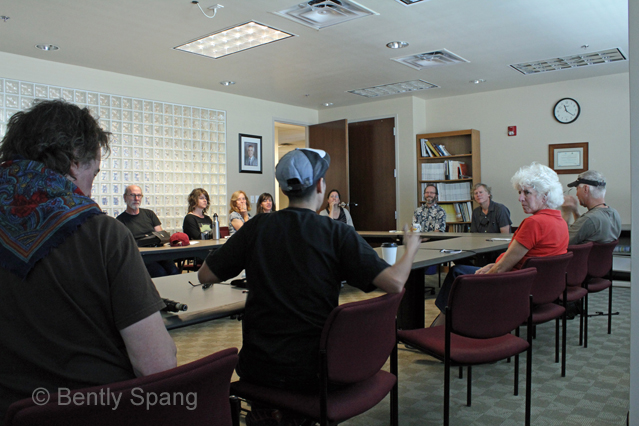
Meeting with Johnathan Overpeck and Gregg Garfin, Institute of the Environment, University of Arizona.

In a weeks time, we hurtled from one remarkable destination to another: Biosphere 2 in all it’s magnificently manufactured glory, a sci-fi-esque experiment from the 90s that has become an international leader in climate change research, the Ceunca los Ojos project nestled in the Arizona mountains and hosted graciously by Valer Austin, across the border to Mexico with Valer to view the rest of Cuenca los Ojos’ incredible work revitalizing the ravaged landscape and restoring the water table, all the while fueled by Phillipe’s incredible cuisine.  This journey-to-the-center-of-the-earth format created a powerful camaraderie amongst the artists, our hosts and the scientists/activists/presenters, a camaraderie that still resonates or me today.

What this group eventually became had a direct bearing on the nature and intensity of the experiences I had on this trip. In the beginning, I was curious what sort of group dynamic would emerge among the assembled artists. I have found that, in short-term projects like this, groups can easily fly apart or polarize under the pressure of intense travel and information overload.  I’m happy to say that this group thrived on the pressure, and actually grew closer and more cohesive as the project went on.  And it was this camaraderie, the diversity, and the passion of the assembled group of artists and our hosts, coupled with our gifted presenters, that created for me a perfect storm of highly charged moments of learning and group absorption of knowledge that are still impacting me today; kudos to the organizers for their vision and tenacity in bringing together this amazing group.

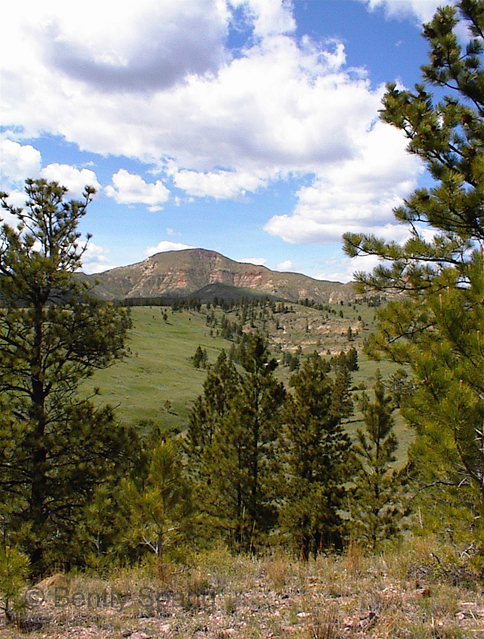
Garfield Peak on the Northern Cheyenne Reservation in Montana.

With each landscape we entered I found myself returning to my reservation homeland in Montana, the dramatic badlands landscape that sustains me and drives my work. This place in southeastern Montana is my reference point for the rest of world and all other landscapes are run through its filter.  It resides at my core and at the core of my people the Tsistsistas Nation as we call ourselves (or Northern Cheyenne as we have been called).  My relatives in the past endured incredible hardships and even gave their lives so we would have this homeland

This place is My Forest not The Forest. It is a specific place on the earth that my people have known in great detail for centuries, not the generic space of bureaucratic fantasy referred to loosely as The Forest (I believe each of us has a My Forest, one with deep personal meaning). And, Indigenous scientists/practicioners have engaged (and continue to engage) their forests all across this continent and around the world and have done so for centuries, compiling data, recording observations, proving theories and handing that information on to subsequent generations.

My Forest is a place I have come to know as personally as a family member during the course of my life.  I have walked on it, crawled across it, ridden horseback over it, harvested plants and animals from it, and buried loved ones within it, just as did countless generations of my people.  My earliest memories are of digging roots, picking berries and hunting deer on this land with my family.  The outings, disguised as family picnics, were really ‘Tsistsistas University’ classes with my grandparents and other relatives and elders (the professors) teaching us the details of this place and our history on this land.  Their curriculum was handed on from centuries ago and was designed to be taught at any given moment during the day: all day, everyday.

My Forest, like so many others, is also an embattled space. My people have fought for years, and continue to fight, to keep coal development off our reservation. Hundreds of years ago, our prophet Sweet Medicine predicted that one day crazy people would come to the Tsistsistas people and ask us to dig into our homeland with them, and if we did so we would go crazy too and cease to exist as a people.  This prophecy has come true and today we know that one of the largest coal reserves in the world sits under our reservation and we have spent decades chasing away the crazy people: the coal companies and the federal and state government officials, who salivate over our rare and highly-prized, low-sulphur content, low-overburden coal.

It’s little help that our reservation is situated in an area the federal government has designated a ‘National Sacrifice Area,’ essentially all of eastern Montana.   A deceptively poetic phrase, in reality ‘National Sacrifice Area’ means that the restrictions on the extraction of minerals are greatly reduced.  Unfortunately eastern Montana is a place that fails to generate the tourism-based tax revenue of mountainous western Montana and so has been offered up for sacrifice to the strip miners shovel.

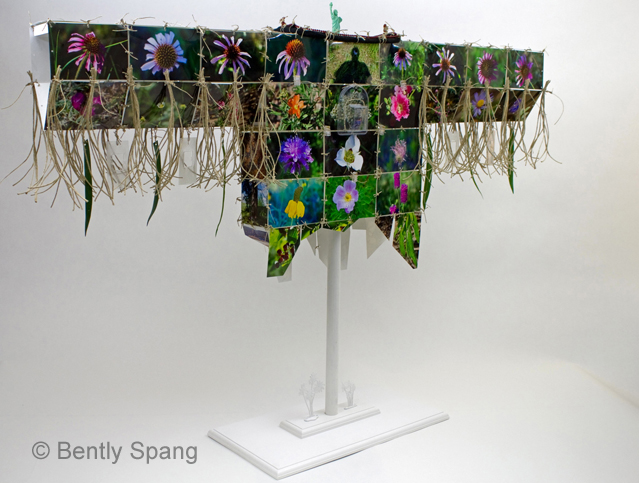
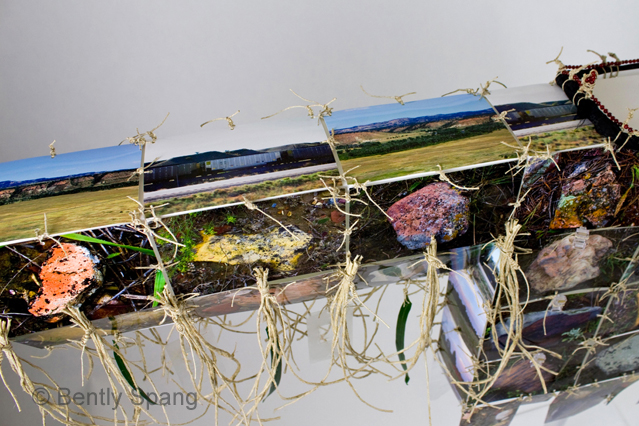
"Modern Warrior Series: National Sacrifice," Bently Spang, 2011, photos, hemp, misc. Collection Denver Art Museum

Detail: National Sacrifice, Bently Spang, 2011.

Now strip mining or surface mining, which devastates the top 100 feet of the earth, is at our doorstep just outside the boundaries of my homeland.  And though we are a sovereign nation and our homeland is not subject to the ‘National Sacrifice’ mandate, the earth outside our doorstep is subject to the mandate and threats of coal development and it’s crushing physical and social toll loom large on our horizon.  It’s presence just off the rez has also eroded our resolve to deny it access to our land, as is evidenced by a referendum vote in 2006 in my community that, for the first time ever, approved conducting a feasibility study concerning whether or not to pursue coal development; a clear shift in sentiment as all previous referendum votes coal development were soundly defeated. As I speak today, my nation’s leadership is in negotiations with 5 coal companies and the plot continues to thicken.  In response to this newly emboldened threat of coal development, in 2011 I created a sculptural work that responds directly to this issue which I titled National Sacrifice. It was commissioned by, and is in the collection of, the Denver Art Museum. It calls attention to this issue, as well as to the incredible National Sacrifice my relatives in the past made so that future generations would have a homeland: a place where we could keep our people and our culture alive.

Every landscape we encountered during Artlab held echoes of my homeland. The cacti around Biosphere 2 were relatives of the prickly pear cactus on our land. I saw a nearly exact duplicate of the man sage plant my people use but it had no sage smell (curious…). The cedar varieties were similar but somewhat more varied. I discovered a close cousin to the plant we call Old Man Whiskers near Valer’s place and the ponderosa pine tree that covers our land, a close cousin of it stood like a group of old friends up the creek from Valer’s place. These, and many others, are plants we use in several ways in my community: as medicine, as food, and in the context of ceremony. Their uses were discovered by Indigenous scientists/practitioners and have been handed on through many generations of Tsistsistas up to today.  When I go to other people’s forests I look for these plants, they give me a measure of comfort. They also remind me how intertwined and interdependent our ecosystems are and how, were it necessary, I could survive in just about any landscape.

I was gratified to see threads connecting my homeland to the Artlab landscapes and to realize that the complexity of I and my people’s experience with place, (both positive and negative) was mirrored in these landscapes.  Each place we visited we were shown the layers of interaction there, the spectrum of human activity on that land—from the complete and utter decimation and exploitation of place to the complete nurturing of it.  I saw that the passionate and gifted scientists and activists who presented their life’s work to us, though often differing in methodology and intent from my people, had the same level of curiosity and hunger for knowledge as the Indigenous scientist/practitioner had in the past and does have today about the natural world.  Most importantly, I saw that, across the board, concern for the welfare of the earth was strong among the scientists and activists we met, so strong that people have devoted their lives to this end just as we have for centuries in the Native community.  These realizations provided me with fresh insights into the scientific world and helped dispel my own misconceptions about that realm.  They would also help temper the challenging moments of my Artlab experience.

As a Native person moving through the Artlab experience, wonderful though it was, inevitably difficult cultural issues arose for me. These are issues that are deeply imbedded in the land for me and my people and that arise from the countless layers of human interaction there, both good and bad.  They are part of the history of this land yet are not often discussed at any length. I bring them up here not to reopen wounds or assign blame, but rather to foster a realistic,  frank and ultimately beneficial discussion about the nature of place which includes an unflinching look at the past and present.  Fearless discussions like this will not only help foster resolution of these difficult issues for both sides, a resolution that is long overdue, but it can also build trust and provide the strongest possible framework for change.  And, only through such fearless discussions can we be assured that the best people and best possible solutions to climate change, and other issues of place, are reached.  Certainly, in order to involve the Indigenous scientist/practitioner in finding solutions to climate change, which I believe is a crucial missing piece within the climate change efforts, this frank discussion must take place.

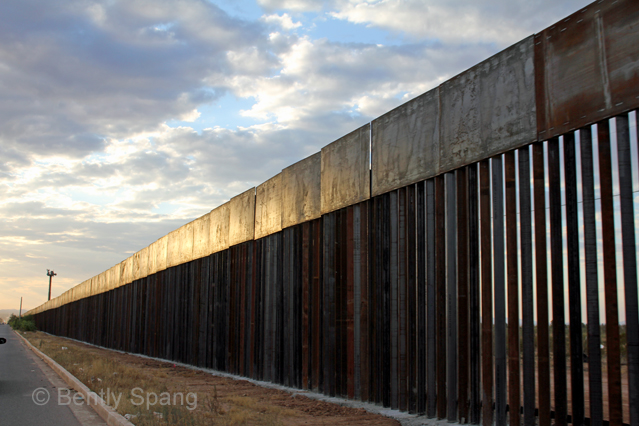
Proposed border fence between Mexico and the US.

And while I am eternally grateful to the scientists for so selflessly sharing their life’s work with us during Artlab, I struggled with a cultural bias that is deeply ingrained in me and countless other Native people with regards to science. It is bias born out of a legacy of extremely difficult  interactions—both older and more recent—between Native peoples and scientists It is a harsh historical reality that, unfortunately, resulted in genocidal acts towards my people in the name of science in the past (cranial studies and human remains,  see here, [note the issues of NAGPRA and the border fence with Mexico]) , and much less severe but still unethical acts (biocolonialism, molecular colonialism, etc., see here ) that continue today.   To be sure, the genocide of the past is, thankfully, a thing of the past, however the residue remains and new issues arise regularly.  Today, both sides are working to rectify this situation, yet the challenges clearly remain (see here).  And though this conflicted history had no direct correlation to any part of my Artlab experience, it is an undeniable, unresolved and intextricable part of my experience as a Native person.

The Native communities’ difficulties with the scientific community are, unfortunately, among the core elements that comprise the historical trauma/grief (see here) that has led to many of the unhealthy social issues we are dealing with in our communities today. The extreme hardships—genocide, broken treaties, boarding schools, etc.—Native peoples endured in the not so distant past in this country were unprecedented in Native history, therefore few cultural mechanisms were in place at the time of they occurred (ceremonies, etc.) to resolve them.  With no means of resolution, the grief and trauma of these atrocities were handed on generationally to this day. Today, we are working hard to resolve this historical trauma/grief in our communities, drawing from the inherent flexibility of our cultural structures, the intellectual power of our cultural information, and the tenacity of our people to devise new strategies for survival.  One example of this is the 1990 Native American Graves Protection and Repatriation Act (NAGPRA) mentioned in one of the links above, an act that one of my elders the late Bill Tallbull, Sr., among other brilliant Native leaders, was instrumental in passing.  This act requires that museums who receive federal funding work with tribes to  return to them human remains, sacred objects, and personal objects in their collections (see here).

As I mentioned earlier, my Artlab experience helped temper my cultural bias with regards to science.  It helped me to understand that it is possible to bridge this chasm that exists between science and the Native community, but that it will take a concerted effort on both sides of the divide and a consistent dialogue between the two camps. Artlab provided me with unique and extremely valuable insights into the scientific community, both intellectually and on a human level.  Sitting across the table from brilliant scientists and being given access to their significant spaces, being immersed in a transformed landscape with the tireless lady who helped foster that transformation, these experiences reminded me that there is a deep level of concern and compassion fueling the climate change movement today.  It also gave me the opportunity to raise awareness of the centuries old existence of the Indigenous scientist/practitioner to the scientific and activist community, helping them to see the need for collaboration between the two groups. These are extremely rare opportunities for a Native person as we have rarely been included in a meaningful way as active participants in the climate change movement.  Artlab, and programs like it, then are providing critical linkages between historically polarized groups—scientist, artist, Indigenous scientist, cultural worker, etc.—which will ensure a more comprehensive and consequently more beneficial dialogue and more effective action with regards to climate change.

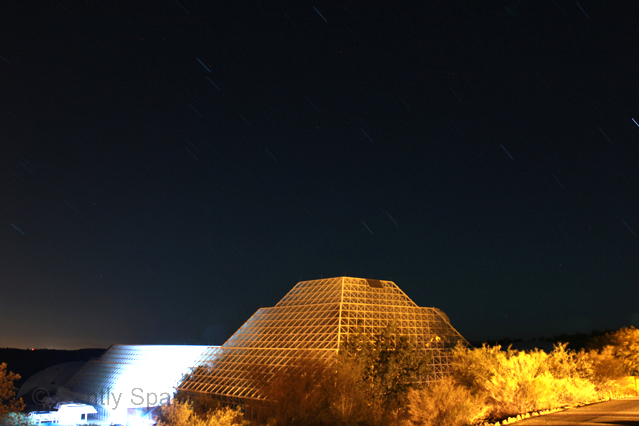
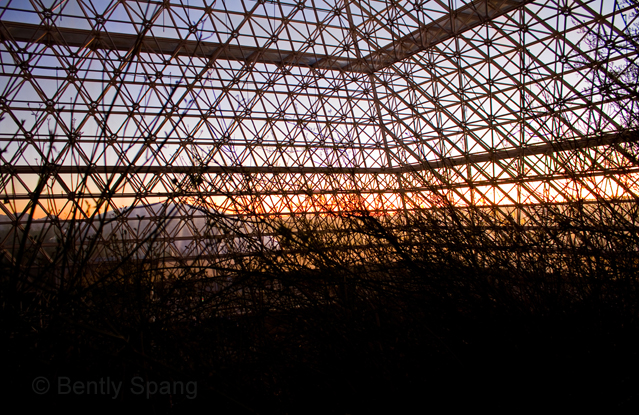
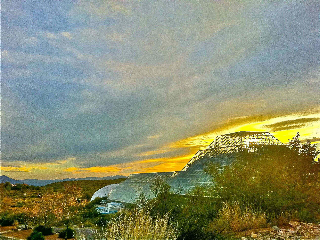
Long exposure night photo of Biosphere 2.

The immersive nature of the Artlab experience helped me to understand even clearer the critical role of the Indigenous scientist/practitioner in the current matrix of climate change activity.  These Native experts have always been, and continue to be, champions of protecting the environment.  I have always seen the need for more Native involvement on numerous scientific fronts, yet had never been able to see firsthand the potential ‘fit’ between the two camps until I was ‘dunked’ in these new environs. Once dunked in the Artlab experience, then, I was gratified to see some of this fit already taking place.

As an example, I was not surprised to discover that the trincheras or atajadizos (also called check dams, see here p. 71) used in parts of the Cuenca Los Ojos project were of Indigenous origins. These are forms used for centuries by Indigenous peoples to sustain their way of life in a challenging landscape.  Kudos to Cuenca Los Ojos for adopting their use and not wasting valuable time re-inventing the wheel.  Just as this ancient technology is working today, so too do living Native peoples hold significant knowledge that could be extremely beneficial to understanding the earth.  Combine this knowledge with the scientific communities studies, the expression of artists, and the efforts of activist groups and the potential is unmeasurable.

To be sure, there are many pressing issues in the Native community that are a higher priority than climate change: historical trauma, issues of sovereignty, teen suicide, to name but a few.  The simple truth is, as Native people, we have always dealt with climate change issues: it is part and parcel of who we are. I am not a medicine person and so will not discuss details of ceremony, except to say that the earth and it’s well being are woven into our ceremonies and we renew the earth in this way, each and every year, for all human beings. Respect for the earth is also woven into the everyday protocols that govern our actions as individuals and we are taught to harvest from the earth in a balanced way. We will continue our climate change work irregardless, however that being said, the potential of combining western scientific and Native approaches toward a multi-pronged effort is an exciting prospect.

The Artlab experience continues to resonate in me and several possibilities for an artwork are rising to the surface.  I have been compiling some of the extensive video footage I shot during the project into a possible multi-channel video installation.  Also, I was recently invited to participate as a presenter and panelist at a Native climate change symposium called Echoes of the Earth,( http://buffalosfire.com/echoes-of-the-earth-indigenous-perspectives-on-art-and-climate-change-conference-in-bozeman-april-5-6/) and I will be presenting some of what occurred during the Artlab trip at this symposium.

As I mentioned to the scientists at Biosphere 2, I see our role as artists in this project as translators, passing on our version of what we have gleaned from their generously accessible presentations in our own visual language to our particular audiences.

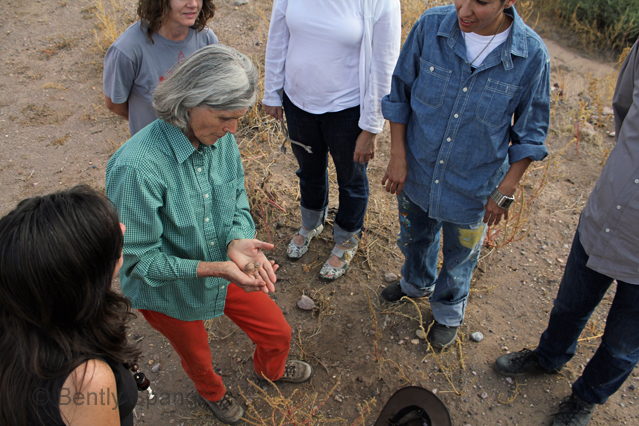
Valer showing our group a toad that returned to the reclaimed land at the Coronado Ranch in Mexico.

As such, I work to devise the best possible translation of this experience to present to my Native community and the larger community as well.  I also am interested in continuing the dialogue around possible Indigenous and western collaborations in curbing climate change.  I applaud the organizers for their extraordinary efforts in bringing this project together and many thanks for including me as part of such a powerful group of artists.

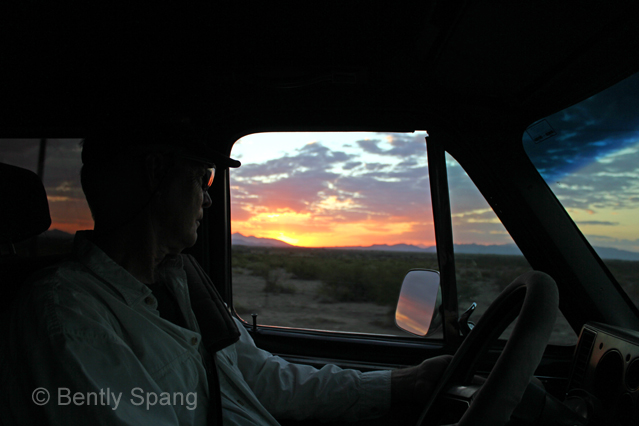
Final thoughts.  Still visible in my mind’s eye: Breathtaking—riding in John’s chevy van, an impossibly gorgeous sunset chasing us and Neil Young back from Mexico to Valer’s place; Unsettling—a hundred miles inside Arizona nowhere near a national border, the way-too-friendly, fresh-faced border patrol agent way-too-nicely interrogating us, “have a terrific day!” he said as we drove away; Exhilarating—almost dark, our guide, Jane and I race the cockroaches out of Biosphere 2, suddenly the lights shut down for the evening and it’s pitch black for a few seconds until my headlamp kicks in; Triumphant—1 o’clock in the morning, pitch black, finally seeing Jupiter and it’s moons through the telescope at Valer’s and me, Melo, David and his wife cheering and dancing around like kids in the middle of a horse pasture.

Art Lab Brings International Group of Artists to Meet With Scientists at Biosphere2


Tucson, AZ (11/11/11): For the second consecutive year, seven artists were invited by Art Lab to participate in Border Biosphere Exploration 2011, where they met with scientists and environmentalists to learn about the effects of climate change on the desert Southwest and then design a cultural response informed by the experience.

The artists represent an international cross section of various disciplines including digital media, mixed media sculpture, performance, installation, photography, painting and film. Fritz Buehner (New York-Boston), Eduardo “Pincho” Casanova Arosteguy (Montevideo, Uruguay), Melo Dominguez (Los Angeles-Tucson), Heather Green (Tucson), Jane Marsching (Boston), Macarena Montañez (Montevideo, Uruguay), and Bently Spang (Montana). All have been working in the field of environmental art.

As Art Lab Creative Director, I coordinated with Biosphere 2 scientists Joost van Haren, Kolby Jardine, Greg A. Barron-Gafford and Sujith Ravi to facilitate interaction with the artists. On the first day of their three-day visit, the B2 scientists were invited to join the artists for an informal discussion about art and science interface over breakfast, lunch and dinner, prepared by Phillippe Waterinckx, founder of Tucson Community Supported Agriculture.

On day four, Art Lab Technical Director John Newman drove the artists to the Institute of the Environment where they met with Jonathan Overpeck, Co-Director, Institute of the Environment, and Gregg Garfin, Deputy Director for Science Translation & Outreach before proceeding to Coronado Ranch and Cuenca Los Ojos Ranch, located on the Mexican side of the border.

Under the direction of Valer Austin, the artists spent three days touring the ranch where they learned its history and of her extensive efforts to re-establish plant life and animal migration. An impressive system of gabions promoting water retention, essential to restoring the land, has been built throughout the ranch.

The group was joined by Diana Hadley, Associate Curator, Arizona State Museum, and Yar Petryszyn, Assistant Curator of Mammals at the University of Arizona at Cuenca Los Ojos where they led discussions on animal migration, drought and ranching in Southern Arizona. They artists also learned the history of the San Pedro River, the last significant free-flowing river in the region, considered to be of paramount ecological and environmental importance, particularly to avian migration.

“I sincerely applaud the organizers for bringing together such a diverse, wonderful group of people,” said Bently Spang, a Northern Cheyenne artist who recently had an exhibit at the Brooklyn Museum. “I truly feel that we created a bond between the group of artists and with the scientists and environmentalists that will endure beyond the parameters of this project.”

A festive gathering of the participants was held at the Tucson home of Cathrene Morton marking the close of the busy week. The artists then returned to their studios to assimilate their experience and produce a work of art for Art Lab. The works will be posted on the Rillito River Project website at www.RillitoRiverProject.org.

Melo’s Journey


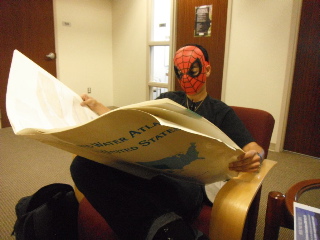
melo spidey

My experience being part of the Rillito River Project was an amazing one. Originally from Los Angeles and now a Tucson resident, The Rillito River Project exposed me to a lot of valuable information about the environment and inspired me to learn more. Our experience began at Biosphere #2. We spoke to many different scientists about their work and our group was given a tour of the biosphere. The thing about the Biosphere is that you have to think of it as a living thing you are able to walk through and semi control. It’s a very cool experiment.

After our 4 days at the Biosphere we headed down to Cuenca Los Ojos in the Chiricahua Mountains. We stayed at the Coronado Ranch, an amazing place. Valer Austin has many acres of land both on the U.S. and Mexican side of the border. She invited us to see what she has done to raise the water table and reestablish native grasses on her land by building simple rock dams called gabions. We also had a chance to see how the border not only keeps people from their natural migration but also keeps animals from their natural migration. Being on the Coronado Ranch and meeting with Valer was a very inspiring experience. We had the opportunity to see what one person can do to make a huge change for the better.

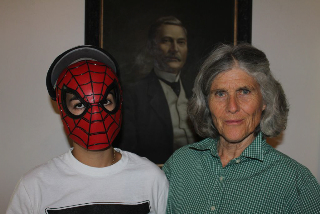
melo and valer

I learned a lot from this experience. With this new knowledge I would like to use my skills as an artist to share it with others. I feel that if people knew more about how climate change is effecting our environment they would be willing to make the necessary changes. The first project I have in mind is to create a painting of the Mexican Free Tail bat. It lives in Tucson six months out of the year and helps our local farmers control the bug population. It also eats mosquitoes and is a delight to have as a summer resident. I would then love to make my painting into a large-scale mural that the people of Tucson can appreciate and learn from. This is the project I would like to do as a direct result of my Rillito River Project, Art Lab, experience.

Hope and uncertainty


Learning in dialog with scientists, conservationists, naturalists, astronomers, activists, and artists at the Biosphere 2, The Institute of the Environment, and Cuenca Los Ojos was an exercise in interweaving uncertainty and hope.  At the Biosphere in discussion with scientist Sujith Ravi, the challenges facing the southwestern grasslands were enumerated thoroughly.  Water usage changes, desertification, drought, invasive species, rising temperatures–all the data presented a bleak and uncompromising picture.  At The Institute of the Environment in discussion with Dr. Jonathan Overpeck, the frustrations of scientists who feel misunderstood and suppressed were emphasized.   Climate change is here, policy is not changing, behavior is changing too slowly, and the mechanisms of capitalism in service of endless growth work against the needs of climate recovery.

Its hard to make artwork in the face of these questions.  Complex, abstract reams of undifferentiated data about the future lack a felt reality.  The timescales are long and the sweep of effects broad, but it is in looking at the shorter timescales and local experiences that the abstract becomes real.  Those local discussions were riveting and even hopeful, whether learning of the work of how to fight the disastrous effects of the invasive species Buffel Grass as it spreads rapidly through Tucson and surrounding areas, so clearly shown by Lindy A. Brigham, Executive Director of the Southern Arizona Buffelgrass Coordination Center, or Valer Austin’s determined remediation of desertified land to restore biodiversity in the Chihuahuan Desert on her ranch Cuenca Los Ojos.

The Art Lab Biosphere project provided an incredible, rich, and surprising experience for discovering the key questions around climate change in the Southwest, challenges in working across the studio and the laboratory, and the importance of dialog and connectivity in research and community.    My project, Avian Field Stations, has a new research focus: grasslands birds in the Cuenca Los Ojos area.  I look forward to returning to Tucson and the Chihuahuan desert in the early summer to conduct field research, develop alliances with researchers, and test prototype works.

One Thousand Bees


Many things impressed me during my week–long ART LAB residency. The first half of our experience at the B2 Institute taught me about the quiet urgency of invasive species coupled with drought and imminent climate change in the southwest. Scientists Sujith Ravi, Greg Barron-Gafford and Lindsay Bingham imparted their knowledge about these issues: how native plants have adapted the use of open spaces between them to balance their use of resources and prevent widespread fire damage, and how now Buffle Grass creates connectivity between these—when burning it can travel the length of a football field in 3 minutes flat, destroying native vegetation forever.

Scientist Yoost Van Haren led us on an enthusiastic and insightful tour inside the biosphere, where we learned about many experiments that aim to study these problems in the desert and others ecosystems beyond. Inside B2 I found the powerful loud fans unsettling, but interesting—the fans are placed throughout B2 in order to aid the trees—which must be lifted up with harnesses as there’s not enough natural wind to develop the strength to support their own weight. It made me think of the lack of native sounds in B2 as well. What happens to a tree without participatory insects and birds or even other species? Aside from the lack of physical wind, what happens to ecosystems with a lack of auditory phenomena? I thought of installing speakers inside the Biosphere with recordings of autochthonous sounds to see if it would be possible to measure any changes over time.

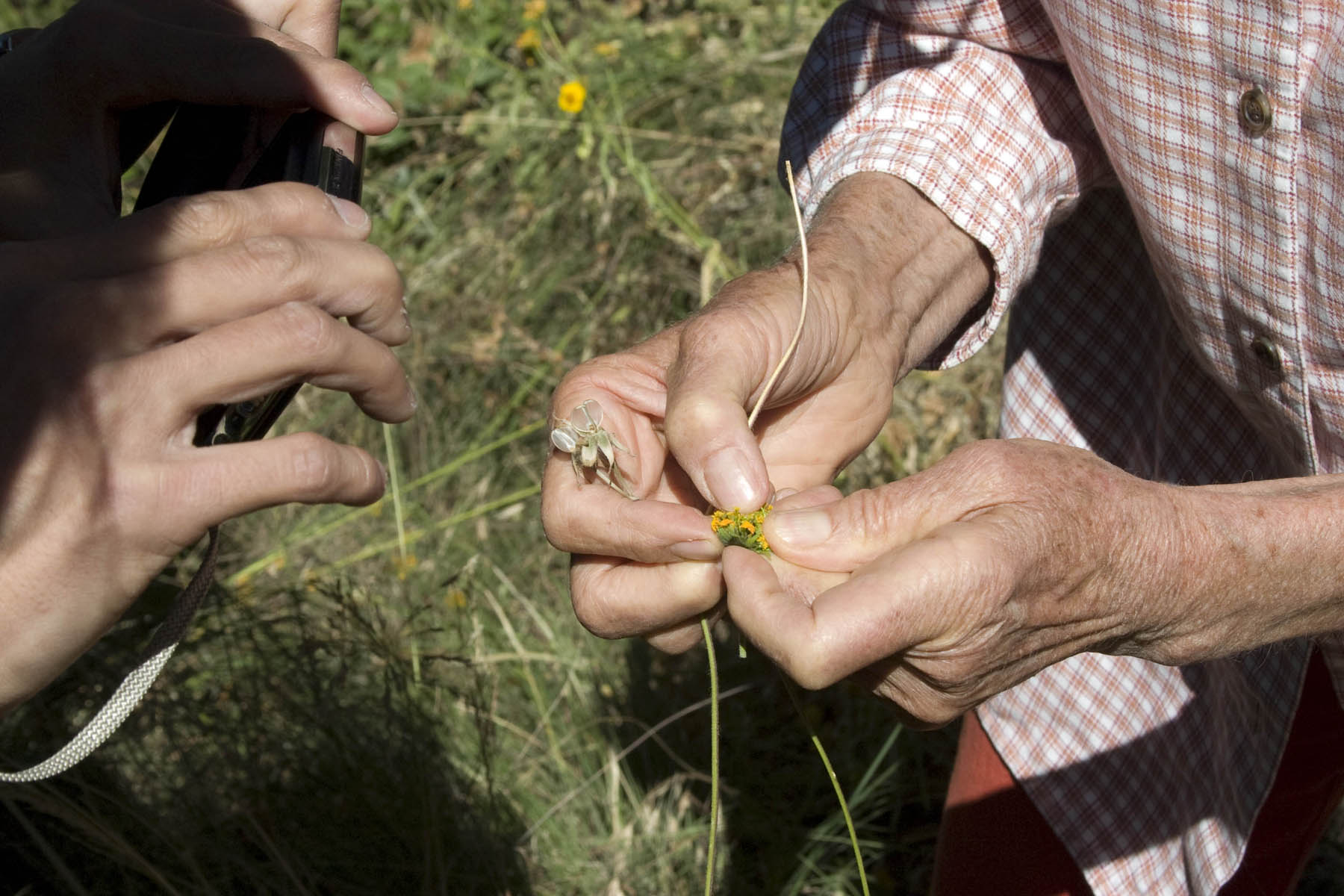
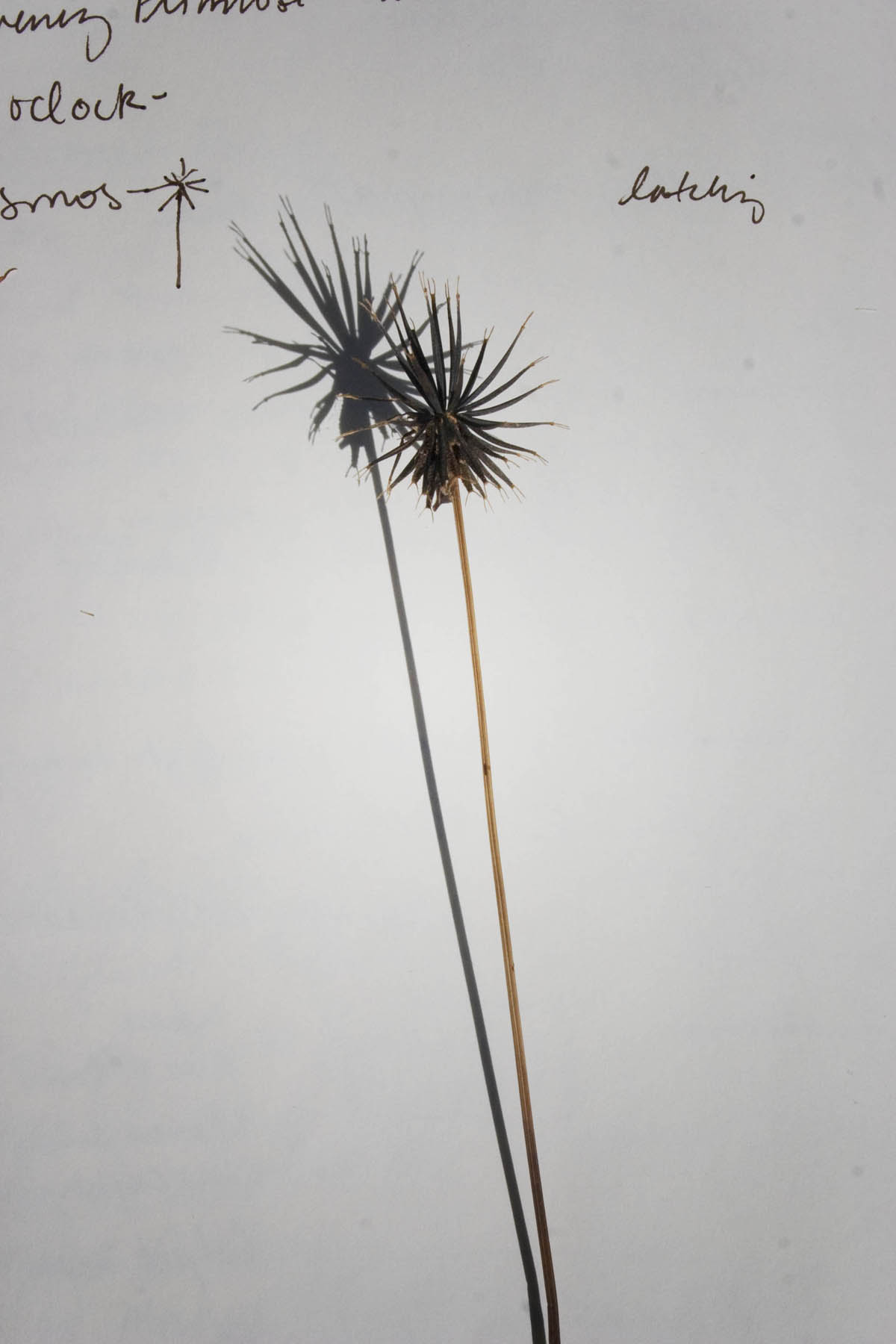
During the second half of ART LAB we were guests of Valer Austin at lovely El Coronado Ranch where we saw first hand how it is possible to restore landscapes that have been scarred with over grazing and poor management, ending the week with a hopeful and inspiring picture. The first afternoon and evening we gathered around the patio with biologist Yar Petryszyn to study a collection of mammal skulls and learn about bats. While seated in a circle passing around skulls a number of honeybees kept aggressively buzzing around and landing on me, making me feel a bit wary. Having kept bees for a season I was surprised by my unease around them. “They’re just honeybees! Why so anxious?” I asked myself. The next day along our walks studying gabbiones and trincheras, Valer stopped to show us a few native pollinator plants that were beginning to take seed and described the importance of disseminating information about planting and preserving seeds on both sides of the border. She impressed upon us the variety of pollinators, pollinator plants and seed dispersal methods, and reported that on her land alone there are estimates of 450 native bee species—quite a number indeed!

Valer showing us seed pod

By the end of our stay at the ranch I felt inspired to assist Valer in getting the word out about these pollinators and plants. But I also felt in awe of the sheer numbers of native bees. I remembered I read somewhere an estimate that the Sonoran Desert has over 1,000 species of native bees, making it one of the most diverse bee population in the world. Back home in Tucson, I decided to meet with a few native bee experts to learn more about native bees. UofA insect behavior researcher Jennifer Jandt and native bee researcher and coordinator of Pollinator Partnership Stephen Buchmann confirmed what I remembered and informed me that the largest threat to native bees is not lack of pollen or plants due to grazing or invasive species, but competition from—HONEY BEES! This surprised me and made me remember those pestering bees back at the ranch. My plan now is to create an installation about native bees that will include a bi-lingual take-away pamphlet about native pollinators and their plants that Valer can use apart from my project.

Seed Pod at El Coronado Ranch

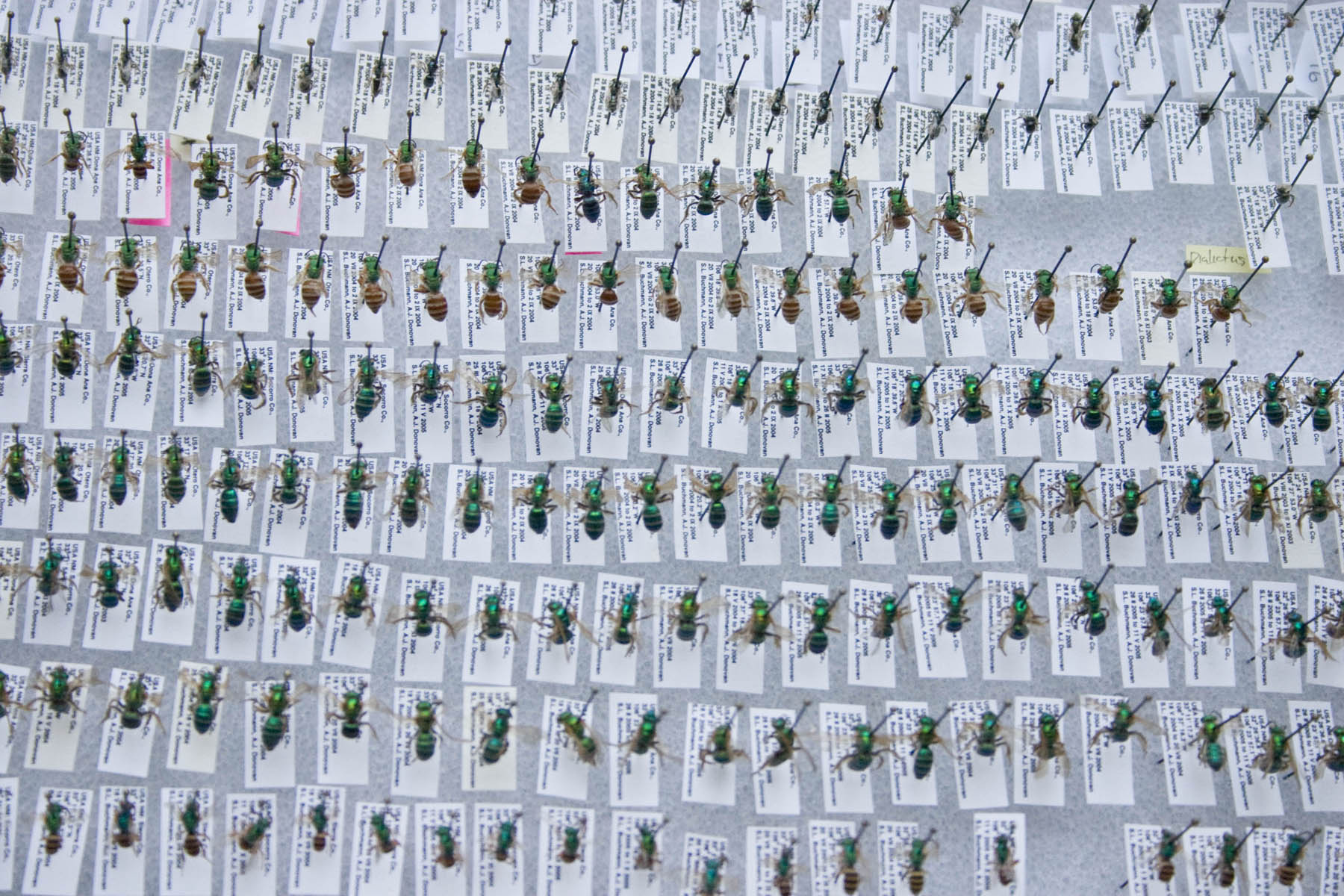
Stephen Buchmann's native bee collection

Travelling North to Oracle


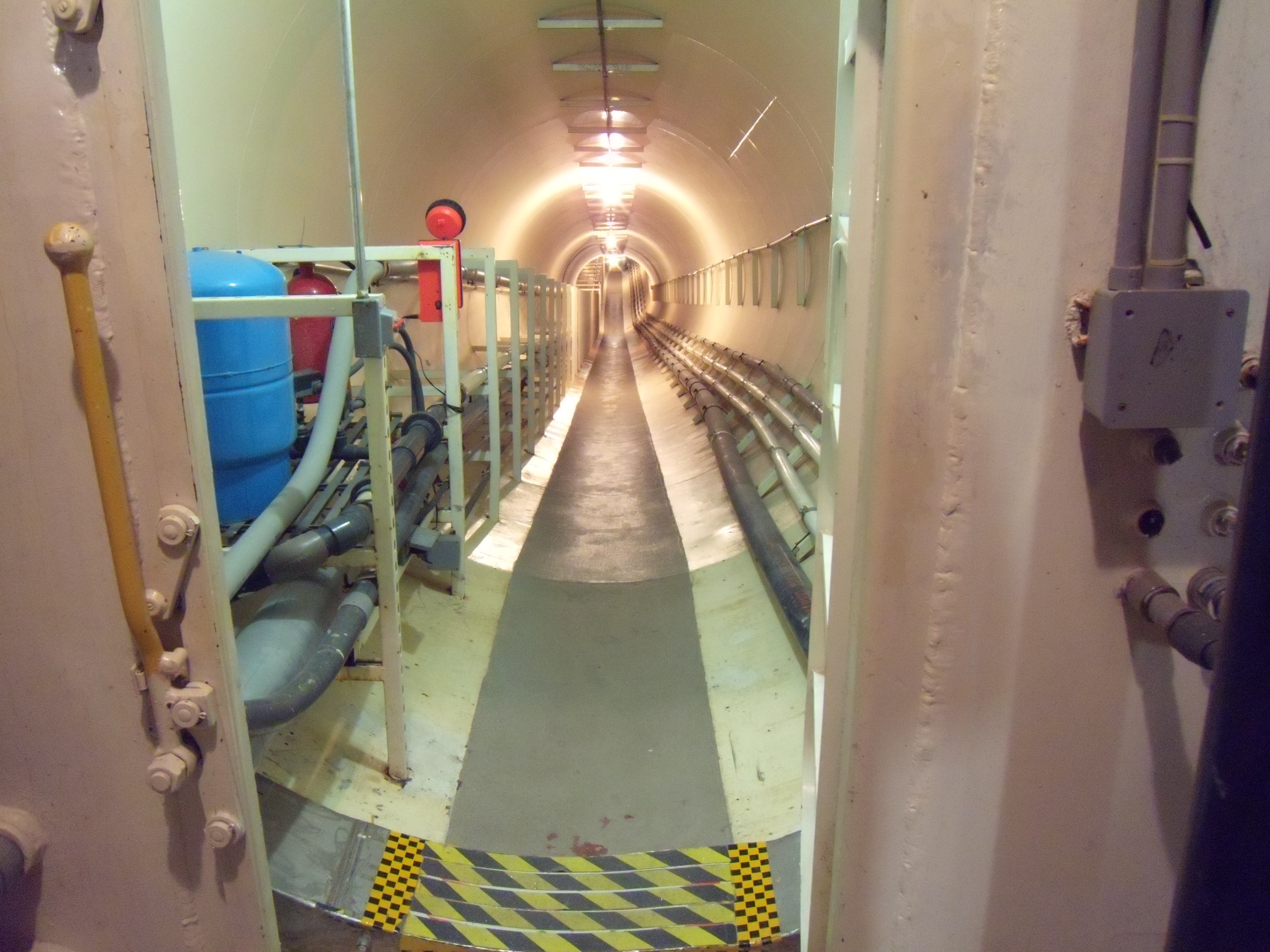
Driving from Tucson north on 77 toward Oracle and Biosphere 2, I’m in awe of the sprawl of rooftops that flank either side of the highway barely visible above the low-lying creosote trees. Knowing this to be a stressed environment I wonder, how can this be sustainable?Tunneling deep into Biosphere’s vast substructure of stainless steel walls, concrete chambers, holding tanks, air filtration systems, still troughs of  condensation, listening to a hydrologist, chemist, biologists, and policy experts tell stories of the regions ecosystems, plant chemistry, water distribution, and invasive plants helped me see beyond the crenellated horizons formed by the sprawling rooftops to something both ironic and promising. Biosphere 2, that began as a utopian experiment to create a portable earth environment for human survival on Mars in some far distant future, now serves as a laboratory for studying and understanding climate that envisions a sustainable environment it in the moment.
When I think about how long scientists have been searching for extraterrestrial intelligence, I see in my mind’s eye the earth, a tiny, but brilliant blue speck sheilded by its fragile atmosphere against the vast fullness of  space as the rarest of things.

The world population is now 7 billion and the competition for resources among all living things fierce.

My personhood will always make me the center of my universe.  The visit to Art Lab, to Biosphere 2, the Chiricahua Mountains, and Sonora desert, with an international group of artists to meet extraordinary people dedicated to revitalising a land degraded through mismanagement was inspiring. Energized at home I can imagine that what may seem incommensurable can be rethought.

To be continued…

“TO”


Sheila_Rocha

“To” is the Dine’, or Navajo word for water.

The dance sequence in the video with the fervent and purely indigenous music is performed by a member of the Itelmen Nation by Tatiana Degai. The tribe is an indigenous nation on the eastern coast of Russia. Water is in such great abundance there that it is honored by way of acknowledgement of the many living beings, four legged, water and winged beings that reside there.

“To” from Shelia Rocha on Vimeo.

The dance she performs is a dance done by the maidens along the shore of the the water.  It is an old one that is done in the presence of the single young men of her people.  Tatiana’s dance is placed in juxtaposition with the environment of the desert and the words of the Dine’ actors/dancers who come from the arid climate of Arizona where water is prized since it is often times scarce.

Water as celebration, as sustenance, as a dying relative in this 21st century is honored as an ancient being comprised of pure spirit in this performance piece that engages the voice, movement and music of Native people who currently reside in Tucson, Arizona.

The Water Must Flow


Tucson, Arizona
dan
It was somewhere back in 1975 when the phone was ringing. I was barely tall enough to answer it. It was mounted to the doorway of our kitchen, right next to notches our mom made to show us how much my little brother and I were growing.

I pulled down the receiver and put the phone to my ear.

“Hell-lo”? I said.

“Mr. Cauthorn is an S.O.B.,” was the reply, and the connection went dead.

I was too young to know what those initials actually meant, but I was acutely aware of the hostility on the other end of the line and the cowardly shame the crank caller may have felt after delivering their nasty payload to a child.

I was also aware that my father, Robert Cauthorn, wasn’t too popular at that time. A city council member, he had recently had contributed to a resolution that increased the water rates for people living in the foothills of Tucson. Many cities in the Southwest such as Tucson faced challenges not only in terms of water supply, but also the logistics of transporting water to higher elevations. This feat required extra energy and engineering, and the Tucson City Council members decided that this challenge warranted charging higher water prices to those living in the foothills.

But in general, residents in the foothills tended to be more affluent, and therefore more formidable when it came to protesting council measures that they didn’t like. The protesters weren’t even interested in arguing the point, they simply wanted to kick my dad and several other council members out of office. A man by the name of Fitzgerald led the whole, tea party-esque movement with the help of a connected lawyer. Fitzgerald (I forget his first name) was known as “The Color TV King” and sold them on the corner of Grant and Campbell avenue. I believe the sign is still there, as it may now be registered as some sort of landmark.

The Color TV King was in fact successful in throwing my dad out of office via a council recall. The council members scattered to the four winds. My family ended up in Florida very soon after. This ended being a positive development, as my dad was tired of getting a near poverty level salary while enduring the protests of people who either didn’t understand the rationale behind the water rate increase, or just didn’t care. To this day, Tucson foothills residents pay the same for their water as those that live down in the city. It basically amounts to taxpayer subsidized water delivery.

That bitter episode marked my first encounter with water supply issues in the Southwest. But that was just the beginning. A different type of water issue was rumbling on the horizon. It was brought on by population increases that were putting an increasing strain on the limited underground water supply. Golfing resorts like La Paloma and Canyon Ranch sprouted up and compounded the problem, as golf courses require tremendous amounts of water to be maintained.

These issues weren’t limited to Tucson. Las Vegas residents fought with California farmers for rights to the Colorado river. Farmers needed the river to water the Imperial Valley, some of the most fertile land on earth. Las Vegas needed the water to enable continued city growth. These were both perfectly good reasons to tap water from the river, but it didn’t matter how good the reasons were. There was only so much river. And nowadays if you travel to where the Colorado river naturally flows into the Gulf of California, you’ll find only dry sand. Fish species such as the Colorado Pikeminnow, one of largest species of carp in North America, are now effectively extinct in Arizona, Mexico and Nevada, and only found in the Colorado River headwaters in the state that gives the once mighty river its name. And in water starved Texas, tense negotiations continue with its northern, water rich neighbor Oklahoma. Texas may have oil, but you can’t drink it.

Please forgive the didactic tone for a moment. The term carrying capacity of a given environment is roughly defined as the amount of sustainable life it can support. How much food is available? How much water ? These variables have dictated where populations – both animal and human – have been able to settle in the past. But modern technology and engineering can now enable us to proliferate in areas where natural circumstances would previously never allow, effectively cheating the limitations of carrying capacities. We can turn deserts into golf courses, bring green Eastern style grass lawns to formerly rocky front yards, and pipe more water to new families who move to desert climates. But the water cost of doing this is huge, and it’s a game of diminishing returns. Now it’s no longer a matter of simply raising the water rates. It is getting to the point where cities like Tucson are in danger of running out of local water completely. Have we ever documented a situation where a large town simply runs dry? I don’t know, and certainly don’t know the solution beyond common sense conservation.
I also suspect that as Tucson’s water table drops, particulates and contaminants become less diluted and more noticeable, perhaps even dangerous. Polychlorinated Biphenyls, or PCBs, have been found at certain well sites in Tucson. I now live in Chicago, and am used to drinking the fairly good water that comes from Lake Michigan. I recently travelled to Tucson to visit my parents. My friend Jeff gave me a ride from the airport. We stopped and had lunch at a wonderful Mexican restaurant on 4th avenue. But when I took a drink of the water, it tasted like jet fuel. “What are you talking about?” my friend Jeff responded. “The water tastes fine.” And he proceeded to gulp down half a glass, looking at me like I was a lunatic. “You look so worried,” Jeff said.

But why should I be worried, I thought. All we have to do is negotiate with San Diego to construct a desalinization plant, and then run 400 miles of pipeline from the Pacifc to Arizona. We can pass on the gargantuan energy cost of desalinating and transporting this water to the Arizona taxpayers. They’ll understand, because the water must flow. Man – aren’t I a chip off the old block ?

Naming is Seeing | Seeing is Forgetting


A video by Ellen McMahon

Ellen McMahon

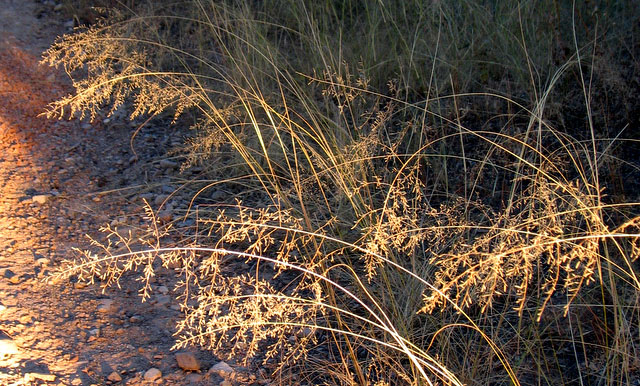
As a participant in Art Lab: Border Biosphere Explorations, I spent a few days at El Coronado Ranch in the Chiricahua Mountains. Surrounded by hundreds of acres of grasslands restored by Cuenca Los Ojos Foundation, I began to learn the identifying characteristics and names of some of Arizona’s native grasses. This new knowledge transformed the field of grass in which I stood into a field of several kinds of grasses then into a field of Green sprangletop, Buffalograss Feather fingergrass, Plains lovegrass, Hall’s panicgrass, Poverty threeawn, Blue grama and many others. Looking closely enough to tell them apart, I saw these individual species of grasses for the first time.

During the residency I happened to be reading Seeing is Forgetting the Name of the Thing One Sees, a book by Lawrence Weschler about the artist, Robert Irwin. The paradox between my reading and my experience resulted in “Naming is Seeing | Seeing is Forgetting” a video about how naming and categorizing both sharpens and limits our perceptions of the world, whether we’re seeing as artists or scientists.

Naming is seeing the thing one sees for the first time.


I experienced solid ground for the first time at nineteen in a plant taxonomy class at the University of Wisconsin. Gradually as I learned about buds, branching patterns, bark and leaf shapes, the confusing forest of my childhood became a series of individual identifiable trees. In this new world of science a Douglas fir was a Douglas and a White oak was a White oak, This fact was not open for the Fruedian interpretations of my father or the art historical perspectives of my mother.

Ellen McMahon

Now, forty years later as part of Art Lab at El Coronado Ranch I walked through a field of tall dry grasses as Valer Austin, said, “Take a picture. It’s all about the grasses.” As founder of Cuenca Los Ojos Foundation she is restoring hundreds of thousands of acres of the border region to the grasslands it once was before the effects of logging, overgrazing and border wall construction. The over fifteen species of native grasses now thriving on the Austin’s massive ranch as a result of water conservation and management–provide nourishment for their cattle and wildlife of all kinds as it protects the soil from erosion.

The next day I walked through the same field of tall dry grasses with my sketchbook and camera to see how many kinds I could identify. Turns out there were nine species within reach on the hillside where I sat. I looked, made drawings and took pictures and video. I didn’t know what the distinguishing traits were so I looked carefully and recorded everything I could see.

A few hours later returning to the ranch the same field was now populated by groups of fluffy ones, tuft-y ones, three branching ones, many branching ones, reddish ones, sticker-y ones, delicate ones, stiff ones, and fountain-y ones… grasses I had come to know by character but not yet by name. After I studied the guidebook and got help from the Austins I went back out to walk through the same field which had been transformed by my new knowledge into Weeping lovegrass, Slender Grama, Feather fingergrass, Green Sprangletop, Tanglehead, Plains Mountain Blue Grass, Poverty threeawn, Deer Grass, and Squirreltail.

blades of ranch grass

The second day I went out with the intention of drawing and photographing more of the diversity of grasses on the ranch but it didn’t happen. Perhaps I had established sufficient ground the day before. Instead, taken by the gentle movement of the grasses in the soft breeze, I shot video. When my memory card was full I went back to my room and picked up my reading, Seeing is Forgetting the Name of the Thing One Sees by Lawrence Weschler.

Bathed in the contradictions between my reading and my experience, I don’t expect to understand the relationships between seeing, knowing, naming and forgetting any time soon. But now when I take my weekly walks up Tumamoc Hill, I’ll think about Dr. Ray Turner and know I am surrounded by the oldest desert vegetation study plots in the world. When I look out over a section of the desert infested with Bufflegrass I’ll know that all of the native vegetation could be wiped out by a single fire. Now I know that over 100,000 people come to the Biosphere annually, many because of the human drama associated with the Biospherians, and they learn about how useful it is as a model for interdisciplinary climate change research. I have a good sense of the multiple stresses on the Southwest environment and the urgent need for more public dialogue and understanding about the trade offs. Occasionally I will think about every living thing on earth having once been part of a star.

In Seeing is Forgetting the Name of the Thing One Sees, Robert Irwin talks about the reasoning in art making and the logic of scientific research. Is the shift I made between naming the grasses the first day and seeing their character in motion the second a tiny example of the shift between logic and reason? How do the qualities and characters of art and science overlap and differ, support each other and work at cross-purposes? Art Lab has been informative and thought provoking. Maybe the work that comes from the experience we shared will shed some light on these questions and relationships.

Cuenca Los Ojos


The US-Mexico Borderland

There is urgency to understand the environmental changes of the last 150 years of the Arizona-Sonora Border region and it’s north-south corridor.  We were given the opportunity to experience this exigency first hand by Art Lab at the Cuenca Los Ojos Ranch in southern Arizona.  Valer Austin, director of the Cuenca Los Ojos Foundation is a generous, infectious power-house and advocate for environmental restoration.

Austin’s projects located on both sides of the border are immense, inspiring undertakings.  Her vision is practical and intricate.  She foregrounds water restoration as her primary goal to re-establish healthy plant life and animal migration.  We learned the story of this land through observing Austin’s courage and passion to bring it back to health.  Her commitment has motivated me to develop a site project to further understand the environmental history of the Arizona-Sonora borderlands and human and nature’s migrations from a cultural and ecological perspective.

Dreaming of a New Biosphere


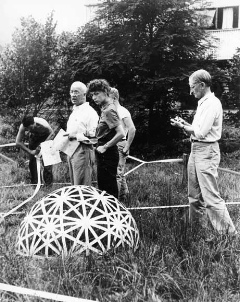
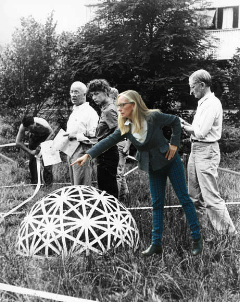
I wanted to be dreaming or imagining Biosphere 2.  The material site extracted my life’s visual memories of cinema, architectural pilgrimages and the beloved, indulgent, unrequited fantasy of having been Bucky Fuller’s student at Black Mountain College.   I long to have been part of Fuller’s “doing more with less” idea and the experiential learning that fueled the dome’s invention, construction and design.

Buckminster Fuller and Ellen DeKooning at Black Mountain College

The ideology and purpose of Biosphere 2’s enormous space-frame structure (rife with iconic architectural quotation that looks back and gazes forward) is under transformation.  Biosphere 2’s new mission and research program promises to bridge the gap between its former closed-system laboratory and field studies, focusing on water and climate and energy and sustainability.  This is a bold sea change from the hermetically sealed structure originally built to house experiments that modeled habitats for extended space colonization and survival.

My attention became increasingly divided between the urgent present-day mission of Biosphere 2 and the big imaginative late twentieth century experiment that was embedded with imperialism and utopian vision.  I wanted to grasp the invention and potential of the current twenty-first century model and to understand the important lessons from the grand imaginative experiment that contained plants, animals and humans in a closed system.

 During our first 4 days at Art Lab, Biosphere 2’s present-day researchers and scientists acted as generous, informed guides, the archeologists and anthropologists we met were inspiring, and the artists courageous.  Regardless of our days lecture topic the dialogue always returned to water and the changes in the Southwest since European contact.  Environmental, cultural and scientific histories, domestic public policy as well as global views were examined.  Ideas and possible solutions flowed.

Photoshopping my way into Black Mountain College

Taoism suggests that we be as flexible as water.  That we become able to let go of old models that don’t work and act with creativity and humility to find new ways of being.  Understanding ways that art can respond to this charge is foregrounding my research and ideas.

Art Lab: Perception


Sheila_Rocha

This journey into earth preservation feels to be just the beginning of a greater understanding of how I can contribute with my art and my hands to the process of geo-healing. As a Purépecha, an indigenous citizen, I have understood what it is to honor our mother the earth through acts of ceremony and conscious caring of the terrain. The Art Lab adventure opens new ways in which I can directly participate in restoration and conservation as an act of intervention. It is clear that all humankind has much work to accomplish in order for mother earth to prevail for our coming generations.

The Biosphere 2 facility provided a unique opportunity for us to interrelate with on-site scientists. Although it brought the issues of hydrology to the forefront, it did not illustrate the omnipresence of the state of climate change that immediately impacts the human condition on multifarious levels. The biosphere provided fundamental background on current research and methodology.

It was our visit to the Tumamoc desert laboratory with Dr. Raymond M. Turner and his work with archive repeat photography that magnified the imminence of climate change. The longevity study on desert flora was one of the missing links I was looking for. Tumamoc also revealed itself as an ancient sacred site—one that is
directly connected over the millennia to its descendents, the Tohono O’odham. What I
observed was scientific appropriation of the area however, total absence of the O’odham in stewardship and protection of these ceremonial ruins—a place where cultural reclamation needs to occur—yet another aspect of preservation.

The full dilemma became clearer as we moved to the U of A for summarization of what we were looking at in terms of total climate modification. However, not until we stayed at Cuencos Los Ojos ranch, hub of the foundation by the same name, did I observe the actualization of comprehensive restoration initiatives.

Here is where things began to come full circle. Here I witnessed Valer Austin, the human trope for environmental conservation demonstrate how human beings have the power to wound as well as to mend our earth. Valer institutes everything from protection and replenishment of natural resources and fauna to water harvesting and education of the larger world community.

This experience, for me, became the “decisive moment”. Art and labor are tools at our disposal. We, as earth citizens, make it or break it for humanity. Now the question…how do “I” contribute to the healing as resourcefully as possible? This realization becomes the springboard for the creative process pulling me into an exploration of sound, image, movement and more.

Stitch: mending the land


Vidar Lerum

While at the ranch, we got to build two small gabions. This physical practical exercise made me appreciate the hard work and the immense effort that goes into this method of land restoration. Earlier that same morning I had listened to Valer talk to me about how it all started and how the system of gabions is working.

Valers_with_Gabion

She then spoke about her vision for a more peaceful future in the border region where land restoration goes hand in hand with providing meaningful employment for young people, making the drug trade a less attractive business to join. A transcription will be made from the video that documents Valers private talk with me. I may also do some video editing and perhaps use Valers voice over moving images. In an effort to visualize the land restoration project at El Coronado, I plan to create a series of graphic images or posters. The base for these posters will be aerial photographs of one particular area taken at intervals over ten years. Cindy was very kind to identify and pull the images that I will use.